The Console on the Chest: When SEGA's Last Stand Became Arsenal's Golden Age
In 1999, Arsenal replaced JVC with a video game console. The Dreamcast died. SEGA exited hardware. Arsenal entered its golden age. The shirt tells both stories — and collectors are still paying for it.
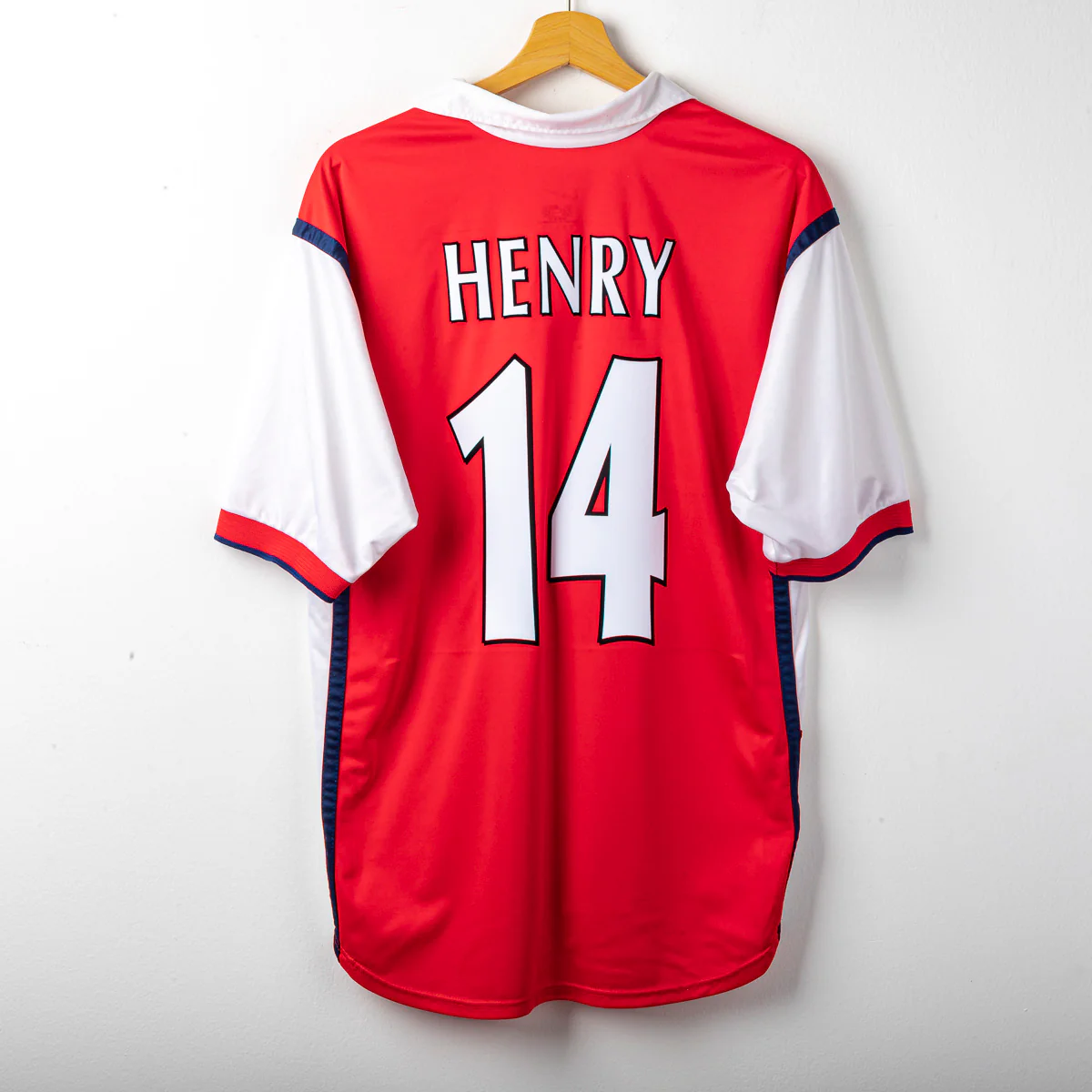
In the summer of 1999, Arsenal Football Club did something unusual. After 18 years with Japanese electronics giant JVC on the front of their shirts — a partnership that had seen them through league titles, cup wins, and the transition from George Graham to Arsène Wenger — they replaced it not with an airline, a bank, or a beer, but with a video game console. The home shirt read "Dreamcast." The away shirt read "SEGA."
It was a deal whose logic worked on two levels: a struggling Japanese hardware company, betting its future on one last console, paid a sum reported in the range of £10–12 million over three years to place its brand on the chest of North London's most stylish football team — though SEGA never officially confirmed the figure, and the commonly cited £12 million appeared in only one contemporary account [1]. By the time the sponsorship ended in 2002, the Dreamcast was dead, SEGA had exited the hardware business entirely, and Arsenal had begun the most successful period in its modern history — built around a French forward who arrived in the same summer as the console logo, scored his first goal in the away variant of the sponsor's branding, and would go on to become the club's all-time record goalscorer.
JVC and the End of an Era
To understand what the Dreamcast deal meant, you have to understand what it replaced. JVC had been on Arsenal's shirts since 1981 — one of the longest-running continuous sponsorships in English football. The JVC logo was a constant through Arsenal's 1989 title at Anfield, the 1994 Cup Winners' Cup, and the arrival of Wenger in 1996. By 1998, Arsenal had just won the Double, and JVC's contract was expiring. The club needed a new partner at the exact moment it was ascending to the summit of English football [1].
Arsenal's commercial team, led by managing director Ken Friar, had options. But they chose SEGA — a company that had not sponsored a European football club before and whose entire rationale was promoting a single product: the Dreamcast, a console that would launch in Europe on September 23, 1999, priced at £199 [2].
The £50 Million Gamble
The Arsenal deal was not isolated. SEGA committed approximately £50 million to a pan-European football marketing campaign. By the summer of 1999, they had signed shirt sponsorship deals with four clubs across four countries: Arsenal in England, Sampdoria in Italy, Saint-Étienne in France, and Deportivo de La Coruña in Spain [2]. They also came close to signing Real Madrid — documents from the period show SEGA offered 1,100 million pesetas per season (roughly €6.6 million), doubling Madrid's existing Teka deal, but negotiations ultimately collapsed [3].
The strategy was unprecedented. No video game company had ever attempted to use football shirt sponsorship as a primary marketing channel at this scale. The closest precedent was Nintendo's sponsorship of Fiorentina in the late 1990s, but that was a single-club deal without the Dreamcast's hardware-launch urgency.
The dual branding was tactically sharp. The home shirt carried "Dreamcast" — the product SEGA needed consumers to know and buy. The away shirt carried "SEGA" — the corporate brand behind it. This split let Arsenal's kit function as simultaneous product-launch vehicle and brand-awareness campaign, visible weekly to Premier League audiences worldwide.
Arsenal's home kit for 1999–00, manufactured by Nike, placed the orange Dreamcast spiral logo across the chest on a deep red shirt — a design now considered one of the most visually striking in Premier League history. The away shirt, navy blue with the white SEGA wordmark, was equally bold.
Home and Away, Dreamcast and SEGA
On August 3, 1999, Arsenal signed Thierry Henry from Juventus for £11 million. Wenger, who had managed Henry at Monaco, converted him from a winger to a striker. On September 18, 1999, at The Dell, Henry came off the bench and curled a shot past Southampton's Paul Jones for his first Arsenal goal [5].
The shirt he was wearing had "SEGA" across the chest: Southampton away meant Arsenal wore their navy-blue away kit, not the Dreamcast-branded home shirt. The Dreamcast logo was never on Henry's back for his debut goal. That detail — the corporate parent rather than the product — captures something about the sponsorship's structure that even Arsenal fans frequently misremember.
Henry would go on to score 228 goals for Arsenal across two spells, becoming the club's all-time leading goalscorer. His iconic flick-and-volley against Manchester United in October 2000 came in the Dreamcast home shirt — one of the defining images of the sponsorship era. The 2001–02 Double-winning season, when Arsenal clinched the league at Old Trafford and the FA Cup against Chelsea, played out in the deal's final year, with the Nike-Dreamcast combination front and centre. By the time Henry scored his solo wonder-goal against Tottenham in November 2002 and his hat-trick against Roma later that month, the shirts said O2 — the SEGA deal had expired that summer. The Dreamcast was already a memory.
The visual record of Henry's emergence — 1999 through 2002 — is inseparable from the SEGA and Dreamcast logos, but the timeline matters: the most iconic moments of the sponsorship era are the ones that overlap with Henry's rise, not his entire prime.
The Console That Died
The Dreamcast launched in Japan in November 1998 and in Europe in September 1999 to strong initial sales. It was technically advanced — the first console with a built-in modem for online play — and had a library of critically acclaimed games including Shenmue, SoulCalibur, and Jet Set Radio.
But it was fighting a losing battle. Sony's PlayStation 2 launched in Japan in March 2000 and in Europe in November 2000, bringing DVD playback and a vastly more powerful marketing machine. The Dreamcast's sales collapsed. On January 31, 2001, SEGA announced it would discontinue the Dreamcast and exit the hardware business entirely, becoming a third-party software publisher [6].
By then, Arsenal were still wearing the Dreamcast logo. The sponsorship ran its full term through 2002 — meaning for more than a year, the club's shirts advertised a dead product.
What the Market Says
The collector market reflects the cultural weight of the Dreamcast-era shirts. Kitdex data shows the Arsenal 1999–00 home shirt (Nike, Dreamcast sponsor) carries a median price of £172.58 across 10 active listings, while the 2000–01 away shirt (Nike, SEGA sponsor) sits higher at £187.49 across 4 listings [7].
These prices place the Dreamcast-era shirts well above more recent Arsenal kits. The 2015–16 Puma home shirt carries a median of £50.37 across 46 listings. The 2006–07 Nike home shirt — the first Emirates Stadium season — sits at £69.99 across 80 listings [7]. The premium commanded by the Dreamcast-era shirts is roughly two to three times that of shirts from ten years later.
A note on methodology: the sample sizes vary considerably (10, 4, 46, and 80 listings respectively), so these cross-era comparisons are indicative rather than statistical. The smaller samples for older shirts partly reflect genuine scarcity — these are 25-year-old shirts — and partly reflect the lower supply of vintage kit on secondary markets. The premium is real, but its precise magnitude should be read as directional.
The 1999–00 home shirt can be found at kitdex.app/shirt/arsenal-1999-00-home and the 2000–01 away shirt at kitdex.app/shirt/arsenal-2000-01-away.
A significant part of the premium is scarcity. But the premium is also narrative-driven. No other Premier League shirt sponsor — not O2, not Vodafone, not Sharp — carries the same combination of cultural crossover and historical irony. The Dreamcast logo is a tombstone for a console generation and a billboard for a player's emergence, printed on the same polyester.
Why It Still Matters
The Dreamcast sponsorship sits at an inflection point in football's commercial history. By 1999, shirt sponsorship was normalised. Kettering Town had been the first English club to wear a sponsored shirt, with "Kettering Tyres" across the chest in January 1976; Coventry City became the first Football League club to do so when their Talbot deal began in 1980. By the time SEGA arrived, the Premier League had been awash in corporate logos for a decade [8]. But SEGA's approach was different. It was not a long-term brand-building exercise. It was a product launch with a three-year fuse, and everyone involved knew it.
Gaming companies did not entirely abandon shirt sponsorship after SEGA. Xbox sponsored the Seattle Sounders' kits, EA Sports appeared on Swansea City's shirts in the early 2000s, and esports brands have appeared on lower-league kits in recent years. But none of these matched the scale or the hardware-era stakes of the Dreamcast deal. The Arsenal-SEGA partnership remains the high-water mark of a video game company betting its marketing budget on stitched polyester and Saturday afternoon television.
In 2026, SEGA is a successful software publisher with no hardware ambitions. Arsenal play at the Emirates, sponsored by Emirates. Thierry Henry is a pundit and manager. The Dreamcast is a retro-gaming curiosity, beloved and obsolete.
But the shirts survive — in collectors' wardrobes, on Kitdex, and in the shared memory of those who watched a young Thierry Henry glide past defenders with an orange spiral or a white wordmark on his chest. They advertised a console that was already dying, for a company making its last stand, during a club's emergence as a modern force. The Dreamcast died. Arsenal endured. The shirts outlasted them both.
Sources
[1] Rosson, Philip. "Football Shirt Sponsorships: SEGA Europe and Arsenal FC." International Journal of Sports Marketing and Sponsorship, June 2001. https://www.researchgate.net/publication/242357759_Football_Shirt_Sponsorships_SEGA_Europe_and_Arsenal_FC
[2] "Sega finalises sponsorship football deal." Marketing Week, 1999. https://www.marketingweek.com/sega-finalises-sponsorship-football-deal/
[3] "Could Have Been Iconic: When Sega Almost Sponsored Real Madrid." Footy Headlines, September 2026. https://www.footyheadlines.com/8501832794/could-have-been-iconic-when-sega-almost-sponsored-real-madrid.html
[4] "Dreamcast and Arsenal – The Greatest Football Sponsor in The Game." Sabukaru, January 2022. https://sabukaru.online/articles/dreamcast-and-arsenal-the-greatest-football-sponsor-in-the-game
[5] Arsenal FC. "On this day in 1999: Henry's first goal." Facebook/Arsenal, September 18. https://www.facebook.com/Arsenal/videos/henry-v-southampton/10154229603952713/
[6] "The Rise and Fall of the Dreamcast: A Legend Gone Too Soon." Sabukaru, July 2022. https://sabukaru.online/articles/the-rise-and-fall-of-the-dreamcast
[7] Kitdex.app — Arsenal club page, shirt pricing data. Retrieved October 2026. https://kitdex.app/api/shirts?club=arsenal
[8] "English football sponsorship." Wikipedia. https://en.wikipedia.org/wiki/English_football_sponsorship
Seed: SEGA Dreamcast / Arsenal sponsorship (1999–2002). Chosen because it's a rare collision of gaming and football at a pivotal moment for both — SEGA's final hardware gamble and Arsenal's Wenger-Henry golden age, with rich collector-market data available on Kitdex.