The Shirt Sent in the Post: How Notts County Dressed the Old Lady
The shirt in question: Notts County 1989-90 Home — median £249.99 across 3 live listings.
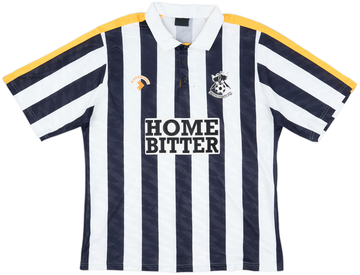
The Shirt Sent in the Post: How Notts County Dressed the Old Lady
The shirt in question: Notts County 1989-90 Home — median £249.99 across 3 live listings.
Cover image: https://kitdex.app/api/images/shirts/52/524febdab615aa8a4840cccce948fd3d4fb1c95c10f52174769cfd6825fbf8f3.webp
In 1903, Juventus Football Club had a laundry problem. The pink shirts the players had worn since the club's founding in 1897 were falling apart. Every wash stripped more colour from the cotton. What had begun as a sharp rose had faded, match by match, into a blotchy, washed-out embarrassment. The club needed new kits, and they needed colours that would survive a scrub [1].
They asked an Englishman named John Savage for help.
Savage was no bystander. He was born in Lenton, Nottingham, in 1867, played for Notts County, and had moved to Turin as one of the wave of English expatriates — merchants, engineers, textile workers — who seeded Italian football in the 1890s. By 1900 he was playing for Juventus as a forward. His old club back home wore black and white stripes. Savage wrote to Nottingham-based tailoring company Shaw and Shrewsbury, requesting new shirts for the club. A parcel arrived in Turin. Inside: a set of Notts County shirts [2] [3].
Juventus put them on and never took them off. One hundred and twenty-three years later, those stripes have survived two world wars, a fascist regime, five ownership structures, a Calciopoli relegation, a nine-season Scudetto streak, and 36 league titles. They have been worn by Platini, Del Piero, Zidane, Baggio, Buffon, and Ronaldo. And they were copied from a club that currently plays in EFL League One — the third tier of English football.
The laundromat origin of an empire
The detail that gets lost in the romantic version is that Juventus didn't choose black and white because it looked intimidating. They chose it because pink was impractical. The original strip — pink shirts with a black tie — was produced by the father of one of the club's early players. It was never meant to be permanent. When the shirts degraded, the club polled its members. Savage, with his Nottingham connections, had a practical solution: he knew a supplier [2].
This is the banality at the heart of most kit origin stories. Boca Juniors got their blue and gold from the colours of a Swedish flag on a ship in Buenos Aires harbour. Athletic Bilbao's red and white stripes came from a Southampton-supporting student who bought 50 shirts on a trip to England and couldn't find any in Athletic's original blue and white. The most visually potent identities in football were almost all accidents — pragmatic choices that became sacred through repetition and success [4].
Juventus's accident was a particularly good one. Black and white stripes have no political affiliation in Italy. Unlike red (communist), blue (monarchist, Savoy), or purple (the colour of the Florentine Republic), black and white signified nothing except itself. This neutrality was useful under Mussolini, when the club was backed by the Agnelli family and the FIAT industrial empire. It was useful during the post-war boom, when Juventus became the club of the internal migrant — the Torinese factory worker. The stripes transcended region. By the 1930s, Juventus was Italy's first truly national club, with fan clubs in every major city. The kit that meant nothing became the kit that meant everything [1].
The man who made it happen
John Savage's career reads like a sketch of football's earliest globalisation. He played for Notts County before moving to Italy, where he turned out for Torino Football & Cricket Club, then Internazionale Torino, then Juventus — all within a decade. He captained an Italian representative side against Switzerland in 1899 in what is now regarded as a precursor to the national team. He also refereed. And he was a tailor by trade, which is either the most poetic detail in this story or the most obvious. A man who made clothes, asked by his club to find better clothes [2].
Savage died in Nottingham in 1951, aged 84. By then, Juventus had won nine league titles. The club he had helped dress in its infancy had outgrown him, outgrown Notts County, outgrown almost everyone. But Juventus never forgot the debt.
The repayment, 108 years later
On 8 September 2011, Juventus opened their new stadium — the 41,000-seat Juventus Stadium, built on the site of the old Stadio delle Alpi. For the inaugural match, they didn't invite Real Madrid. They didn't invite Manchester United. They invited Notts County [5].
The symbolism was precise. Notts County were in League One at the time, playing in front of crowds under 7,000. Juventus were coming off a seventh-place Serie A finish but were still one of the ten richest clubs in world football. The invitation was a statement: we know where our colours came from.
The game finished 1–1. Luca Toni opened the scoring for Juventus in the 53rd minute. Lee Hughes, a journeyman striker whose career had taken him through West Brom, Coventry, and Oldham, equalised in the 87th minute. The Juventus Stadium crowd applauded the goal. A Nottingham-based part-timer had just scored the first opposing goal in the most modern stadium in Italy, against the club his team had inadvertently designed [5] [6].
In 2019, the debt flipped. Notts County, facing financial collapse and relegation from the Football League into non-league obscurity, launched a crowdfunding appeal. Juventus donated a signed shirt for auction. The gesture was small in financial terms but enormous in symbolic terms. The club of 36 Scudetti, of Agnelli and Elkann, of billion-euro commercial deals, was helping the club of Meadow Lane keep the lights on. The circle, 116 years after Savage mailed that parcel, had closed [7].
What the market says
The Kitdex market tells a story of asymmetric memory. Juventus vintage shirts trade actively: the 1982–83 Kappa home kit, worn during the Michel Platini era and featuring the classic Scudetto badge, has a median price of £249.99 across 23 live listings. The 1989–90 Kappa home — a simpler design with the Ariete sponsor logo — moves even faster, at £149.99 across 41 listings, making it the most liquid vintage Juventus shirt on the platform. The rarest entry in the database is the 1960–61 home shirt, listed at £761.61 with a single seller [8].
Notts County's vintage market tells a parallel story at a different scale. The 1989–90 home shirt — black and white stripes produced by an unknown manufacturer during the club's brief top-flight return under Neil Warnock — carries a median of £249.99 across three listings, exactly matching the Platini-era Juventus home. The 1991–92 shirt, from the season County last played in the old First Division, is priced identically at £249.99 with a single listing. A Notts County shirt from the 1994–95 away season can be had for £59.99 [8].
The numbers have nothing to do with each other. The Notts prices are driven by scarcity — the club's fanbase is small but fiercely loyal, and 1990s County shirts almost never surface. The Juventus prices are driven by global demand — 23 listings for the Platini kit means it trades like a commodity. But the visual DNA is identical. Hold a 1989 Notts County home shirt next to a 1989 Juventus home shirt and the stripes are the same. The manufacturers differed. The badge is different. The sponsor is different. The thread connecting them is the same.
The weight of accidents
The Notts-Juve connection gets trotted out as trivia. It is more than trivia. It is a demonstration that football's most durable identities are almost never designed. They are inherited, borrowed, repurposed. The pink shirt that faded in the wash didn't produce a committee meeting about brand strategy. It produced a letter to a tailoring company in Nottingham. And because Juventus then won — and kept winning — the accident calcified into tradition.
There is no parallel in modern football. If a Premier League club announced tomorrow that a fading kit had forced an emergency redesign sourced from a friend at a third-tier club, the story would last one news cycle — then the marketing department would commission a formal rebrand. In 1903, there was no marketing department. There was only John Savage, a parcel, and a club willing to wear what was in the box.
Juventus honour the origin. The club's away and third kits routinely return to pink as a nod to the pre-Savage years. In 2023–24, the third kit was a tonal pink design with black detailing. The pink shirt is sold as heritage. But the black and white stripes are the inheritance — and they came from Nottingham.
The most successful football club in Italian history, measured by trophies, measured by revenue, measured by global fanbase, wears a kit that was never designed. It was chosen. The choice was made by a Nottingham tailor playing amateur football in Turin. A hundred and twenty-three years later, nobody has found a reason to change it.
Sources
- Wikipedia, "Juventus FC" — club history, colours, early years
- Wikipedia, "John Savage (English footballer)" — biography, Notts County and Juventus career
- Wikipedia, "Notts County F.C." — club colours, Juventus connection
- Goal.com, "Why do Juventus play in black and white?" (20 February 2021) — pink shirt fading, John Savage connection
- The Guardian, "Notts County to play Juventus in Turin to mark stadium opening" (14 August 2011) — https://www.theguardian.com/football/2011/aug/14/notts-county-juventus-friendly-stadium
- BBC Sport, "Notts County spoil Juventus party to celebrate new stadium" (8 September 2011) — https://www.bbc.co.uk/sport/football/14847404
- Wikipedia, "History of Juventus FC" — Agnelli era, early years, black and white adoption
- Kitdex API, shirt search results for "Juventus" (https://kitdex.app/api/shirts?q=Juventus) and "Notts County" (https://kitdex.app/api/shirts?q=Notts+County), accessed 7 October 2026 — median prices and listing counts verified against live API