The Shirt That Broke the Queue: How Nigeria's 2018 Kit Became Football's First Global Streetwear Drop
On 1 June 2018, outside Nike's flagship store on Oxford Street in London, something unusual happened. Hundreds of people had been lining up since the early morning, phones out, documenting the wait. T...
The Shirt That Broke the Queue: How Nigeria's 2018 Kit Became Football's First Global Streetwear Drop
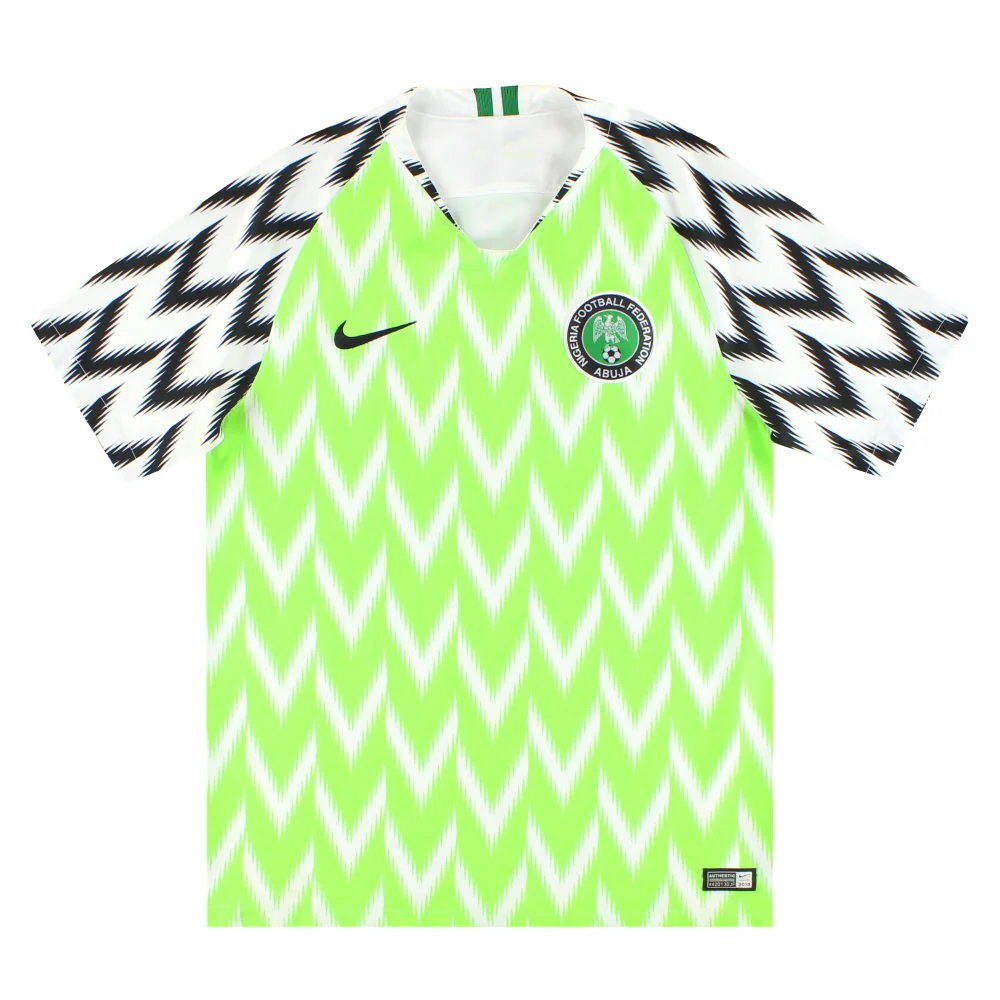
On 1 June 2018, outside Nike's flagship store on Oxford Street in London, something unusual happened. Hundreds of people had been lining up since the early morning, phones out, documenting the wait. This was not a sneaker release. It was not a Supreme collaboration. It was a national football team shirt — Nigeria's home kit for the 2018 World Cup in Russia — and by the time the doors opened, three million people had already pre-ordered it online [1]. The in-store stock vanished within hours: some reports put the sellout at 15 minutes [2], while Nike's own account described it as three hours [3].
The kit was designed by Matthew Wolff, a then-29-year-old graphic designer at Nike and former right winger for Skidmore College's men's soccer team [3]. Wolff had previously designed the badges for NYCFC and LAFC, but the Nigeria commission was different. It was not just a jersey brief. It was a cultural brief.
The Design
The home shirt is built on a vibrant green base — Nigeria's national colour — crossed by a black-and-white geometric chevron pattern across the torso. The sleeves carry a feather motif, a direct reference to the 1994 Nigeria kit worn by the country's first-ever World Cup squad, whose eagle-wing sleeve design became a touchstone for Nigerian football identity [3]. The 2018 version sharpened that reference: sleeker, faster, less nostalgic. Nike Design Director Pete Hoppins described the brief as capturing Nigeria's "supreme confidence" and "youthful squad" [4] — a generation of Premier League players like Alex Iwobi and Wilfred Ndidi who were forging their own reputation [1].
It was the centrepiece of a wider collection Nike branded "Naija" — a colloquial term for Nigeria that the brand used to anchor a full lifestyle range: bucket hats, floral-print tracksuits, feather-pattern training tops [4]. Football kit collections had existed before, but none had been marketed this explicitly as a fashion drop. The product photography showed players in monochrome bucket hats and jackets, not just on the pitch. The messaging was streetwear, not sportswear.
The Frenzy
The BBC reported that three million pre-orders were placed before the shirt went on general sale, citing the Nigeria Football Federation [1]. Queues wrapped around Nike Town London, with passers-by posting photos of the lines on social media [1]. The shirts, priced at £64.95, vanished from Nike's website soon after release [1].
What made the moment atypical was not just the volume of demand but who was demanding it. The queue was not primarily Nigerian diaspora. It was global — a mix of football fans, streetwear collectors, and people who had no connection to the Super Eagles but wanted the shirt because it looked like nothing else on the market. Fast Company called it the best designed kit of the tournament [3]. The Fader wrote that it "instantly became the hottest piece of soccer gear since Juventus's Drake-modeled pink jersey" [3].
Nigeria did not advance past the group stage. They finished third in Group D behind Croatia and Argentina, winning one of three matches. The team's exit made no difference to the shirt's afterlife.
The Market, Eight Years On
Kitdex, a vintage football shirt price index, tracks 44 distinct Nigerian national team shirts currently listed across the resale market [5]. The 2018-19 home shirt holds a median price of £69.99 across seven live listings, with live prices ranging from £44.99 to £95.78 depending on size and condition (a historical listing once reached £157.28) [6]. Sellers include Classic Football Shirts, Vintage Football Shirts, Football Shirt Collective, and smaller specialist retailers across the UK, Switzerland, and Mexico [6].
At £69.99, the shirt trades at a small premium over its original £64.95 retail price — a modest markup that undersells its cultural weight. The real story is volume. Eight years after a shirt was released and not restocked, five retailers across seven listings still carry inventory on a single aggregator. That persistent supply reflects sustained demand: people keep wanting this shirt, and sellers keep sourcing it.
For perspective: Nigeria's 1994-95 home shirt, the Adidas eagle-wing design that inspired Wolff's work, holds a Kitdex median of £249.99 [7]. That is a 30-year-old shirt from a historic first World Cup appearance, worn by Jay-Jay Okocha and Rashidi Yekini — and it carries the premium those facts command. The 2018 shirt has no such tournament legacy. It has something else: the residue of a moment when the lines between football shirt and fashion item dissolved completely.
Comparing across Nigeria's entire kit history on Kitdex reveals a nuanced picture. The 2020-21 home shirt holds a median of £72.03 across 12 listings, marginally above the 2018 shirt's £69.99 — a reasonable outcome for a shirt two years newer with comparable design lineage. But the 2018 kit decisively outpaces its two most recent successors: the 2022-23 home is £47.64 and the 2024-25 home is £51.44 [5]. That an eight-year-old, never-restocked shirt still trades well above two newer editions is a reversal of the depreciation curve that usually governs modern replica shirts.
What the Kit Changed
Before June 2018, a World Cup kit release was a sports equipment story. After June 2018, it was a cultural event. Nike learned the lesson explicitly: subsequent Nigeria collections received dedicated fashion-world coverage, and other federations — notably Jamaica's 2023 Adidas collaboration — adopted the streetwear playbook.
The 2018 Nigeria shirt is not the most expensive vintage Nigerian jersey on Kitdex, nor is it the rarest. What it is, demonstrably, is the shirt that proved a national team jersey could be a crossover commodity — bought by people who did not care who won Group D, worn by people who could not name the squad, and still listed, eight years later, by retailers who know the demand has not run out.
Sources
-
BBC Sport — "World Cup 2018: Nigeria kit sells out after three million pre-orders" (1 June 2018). https://www.bbc.com/sport/football/44333440
-
BroBible — "Nike Had 3 Million Pre-Orders For Nigeria's Awesome World Cup Kit And It Sold Out In Just 15 Minutes" (1 June 2018). https://brobible.com/sports/article/nike-nigeria-world-cup-kit-record-sell-out/
-
Skidmore College News — "Creativity goes viral at FIFA World Cup" (18 June 2018). https://www.skidmore.edu/news/2018/0618-matt-wolff.php
-
Creative Review — "Designing the Nigeria 2018 World Cup kit" (2018). https://www.creativereview.co.uk/designing-nigerias-world-cup-kit/
-
Kitdex API — Nigeria shirts search (44 total). https://kitdex.app/api/shirts?club=nigeria&sort=price
-
Kitdex API — Nigeria 2018-19 Home shirt detail, £69.99 median, 7 listings. https://kitdex.app/api/shirts/nigeria-2018-19-home
-
Kitdex API — Nigeria 1994-95 Home shirt detail, £249.99 median. https://kitdex.app/api/shirts/nigeria-1994-95-home