The £2,100 Shirt: How a Small Italian Brand Made Maradona's Napoli Kits the Most Valuable in Football
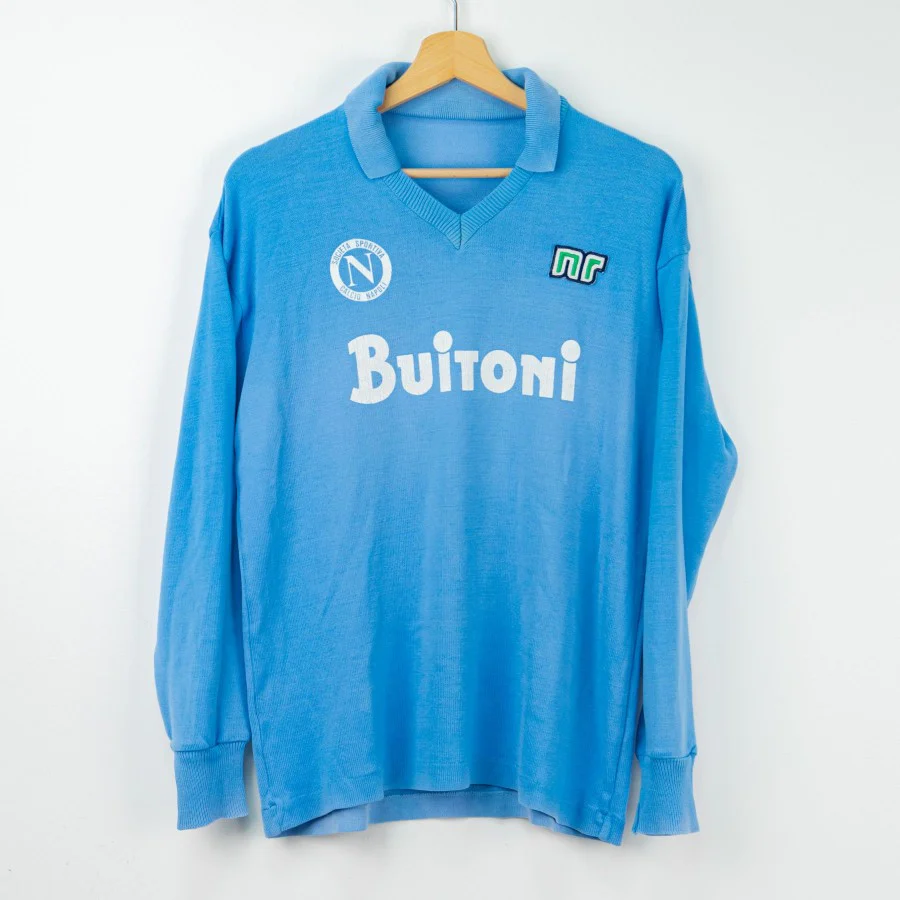
The shirt in question: Napoli 1985-86 Home — median £2,101, no live listings right now.
The £2,100 Shirt: How a Small Italian Brand Made Maradona's Napoli Kits the Most Valuable in Football
The shirt in question: Napoli 1985-86 Home — median £2,101, no live listings right now.
In 1985, a small Italian sportswear company called Ennerre landed a kit deal that would quietly become one of the most consequential manufacturer contracts in football history. The club was Napoli. The player was Diego Maradona. And the shirts they made together — worn across two Scudetti, a UEFA Cup, and the single most mythologized chapter of Italian club football — now trade for sums that eclipse any other vintage football shirt on the market.
A 1985-86 Napoli home shirt, the sky-blue jersey with the white Buitoni sponsor across the chest and the stitched Ennerre logo that Maradona wore in his pre-title bedding-in season, last sold for £2,109. That is not a typo. You can buy a functioning used car for less. And it is not even the most expensive Napoli shirt from the era.
A city, a player, a brand
When Maradona arrived at Napoli from Barcelona in 1984 for a then-world-record £6.9 million, the club had never won Serie A. They were a mid-table side from Italy's impoverished south, derided by northern clubs whose trophy cabinets were already full. The signing was an act of defiance. Within three years, Napoli had their first Scudetto. Within six, they had two league titles, a Coppa Italia, and a UEFA Cup. The city's identity became inseparable from the player, and the player's image became inseparable from the shirt.
That shirt was made by Ennerre — or NR, as the stitched logo read. Founded in the 1970s, the brand was never a global player. It supplied kits to a handful of Italian clubs and the Italian national rugby team, but its name never reached the international recognition of adidas or Umbro. And yet, by sheer accident of timing, Ennerre became the manufacturer of the most culturally significant football kit of the 1980s.
The shirts themselves are artefacts of their era. They are 100% acrylic — heavy, textured, with a distinctive jacquard weave that carried the NR logo repeated across the fabric. The sponsors — Buitoni pasta and Mars chocolate — differ in application: Buitoni is painted on, Mars is printed (in stampa), giving them a tactile, almost handmade quality that modern heat-transfers cannot replicate. The collars are wide and structured. The long-sleeved versions, in particular, became the definitive silhouette of Maradona in his prime.
The Kitdex data
The current market data, drawn from live listings and historical sales tracked by Kitdex, paints a picture that no other club's vintage shirts can match.
The 1985-86 home shirt — the Buitoni season, long-sleeved, acrylic, Ennerre — last sold at €2,490 (£2,109) in excellent condition [1]. This was Maradona's second season at the club, the campaign before the first Scudetto. It is a transitional artefact: the shirt of a team still becoming what it would soon be.
The 1988-89 home shirt, sponsored by Mars and worn during the UEFA Cup-winning campaign, carries a median price of £592, with active listings ranging from £474 up to £1,516 [2]. The Mars sponsor variant with the darker lettering — sometimes called the "Careca shirt" because the Brazilian forward wore it with the number 9 — is particularly prized.
The 1989-90 away shirt — white, with a single blue horizontal band and a geometric front pattern — shows a median of £431 across four tracked sales [3]. It is, by Maradona-era standards, relatively accessible.
These are not aberrations. Compare them to the 1991-92 home shirt — still Napoli, still sky-blue, but Umbro-made instead of Ennerre, and from the season Maradona left the club. Its median price is £47, with 9 tracked prices across 6 retailers [4]. The drop-off is not gradual. It is a cliff.
For context: Boca Juniors 1991-92 home shirts, from the same period and carrying Maradona's name indirectly through the club he returned to after Napoli, trade at £300. The 1994-95 Boca home commands £175 with eight active listings. Even the most expensive Boca shirts on Kitdex — the 1992-96 Away (Unknown manufacturer) at £296 — don't approach Ennerre-era Napoli prices. The Olan-manufactured 1993-95 Away, by comparison, trades at £130 [5].
Why Ennerre?
Part of what makes these shirts so valuable is simply scarcity. Ennerre was a small operation. Production runs were limited. The acrylic fabric, while durable, was prone to stretching and pilling. Few shirts survived three decades in good condition, and fewer still in the larger sizes that fit adult collectors today. A well-preserved 1988-89 home shirt in size L is a genuine collector's event.
But scarcity alone does not explain a £2,100 price tag. Scarce things can still be worthless if nobody wants them. What Ennerre accidentally captured was authenticity. These shirts were worn by Maradona during the most romantic chapter in Italian football — the chapter where a southern underdog, led by a genius with a troubled soul, beat the northern establishment not once but twice. Every painted sponsor, every stitched NR badge, every acrylic fibre carries that story.
The brand itself folded in the 1990s, absorbed and forgotten, which only deepens the mythology. You cannot call Ennerre for a reissue. You cannot buy a retro remake from the original manufacturer. What exists in the market is all there is.
A note on the numbers
One shirt in the dataset requires a caveat. The 1990-91 away — white, with the blue polo collar, Mars sponsor, and the tricolour Scudetto badge celebrating the 1989-90 title — shows a listed median of £864,113. This figure is driven by a single listing from Retro Original Football at €101,999,898, an obvious data entry error. The other active listing sits at £1,524 [6]. Note: a re-edition Maradona #9 of this shirt was previously observed on the market at £219, though it does not appear in the current live listings tracked by Kitdex. The real market for this shirt, sans data glitch, is likely in the £1,200-£1,600 range.
This is the kind of outlier that vintage shirt price tracking — still a relatively young discipline — has yet to fully solve. When a single erroneous listing can inflate a median by three orders of magnitude, the data infrastructure has work to do. But the genuine numbers are still remarkable.
What the market tells us
The jump from £47 to £2,100 as you go from post-Maradona Umbro to mid-Maradona Ennerre is not a story about fabric quality or manufacturing prestige. Umbro is, by any measure, a bigger and more reputable brand than Ennerre ever was. The difference is entirely about who wore the shirt and what it represents.
This is the fundamental dynamic that makes vintage football kit collecting distinct from other forms of memorabilia. A match-worn shirt signed by Maradona is expected to be expensive — that is the autograph market, the provenance market. But a shirt that Maradona simply wore the same model of, with no individual chain of custody, trading for thousands of pounds, signals something different. It signals that the shirt has become a cultural object independent of its specific history. Owning a 1985-86 Napoli Ennerre shirt is not about proving Maradona touched it. It is about owning a piece of what Maradona meant.
Seeds in the market
The data suggests a market that is still finding its footing. The 1988-89 home shirt has live listings at £474 and £1,516, with a recently sold-out listing at £567 — a £1,042 spread across three tracked retailers for the same shirt. The 1989-90 away ranges from £228 to £518. Sellers are testing prices, and the absence of a liquid market means each sale is effectively a negotiation between two people who both know they are handling something rare.
For buyers, the advice is straightforward: verify the fabric (should feel heavy, with a visible jacquard NR pattern), check the sponsor application (Buitoni-era shirts should be painted; Mars-era shirts are printed — cracking is expected and acceptable, peeling is not), and watch for the size. A size 48 (Italian) is roughly a modern medium. Anything larger commands a premium.
For everyone else, these shirts are a window into a moment that will not repeat. A genius from a Buenos Aires slum, a broken city in southern Italy, and a small sportswear brand nobody had heard of — together they made shirts that now cost more than gold by weight.
Sources
- Kitdex: Napoli 1985-86 Home — Ennerre, Buitoni, last sold €2,490 (£2,109), Le 7 Sorelle.
- Kitdex: Napoli 1988-89 Home — Ennerre/NR, Mars sponsor, median £592, 3 listings tracked.
- Kitdex: Napoli 1989-90 Away — Ennerre, white with blue band, median £431, 4 listings.
- Kitdex: Napoli 1991-92 Home — Umbro, post-Maradona, median £47, 9 prices across 6 retailers.
- Kitdex: Boca Juniors 1992-96 Away (£296, Unknown manufacturer); Boca Juniors 1993-95 Away (£130, Olan). Also: 1991-92 Home (£300), 1994-95 Home (£175).
- Kitdex: Napoli 1990-91 Away — Ennerre, Mars, Scudetto patch. Note: inflated median (£864,113) caused by single erroneous €102M listing; real market estimated £1,200-£1,600.