The Grey Shirt That Couldn't Be Seen: How One Kit Rewrote Manchester United's Title Season
Cover image: `https://kitdex.app/api/images/shirts/3d/3d6497861ed16c73f5a3cefbad146f3abbd845edd49e0b002a0e3a5e0cb32ba0.webp`
The Grey Shirt That Couldn't Be Seen: How One Kit Rewrote Manchester United's Title Season
Cover image: https://kitdex.app/api/images/shirts/3d/3d6497861ed16c73f5a3cefbad146f3abbd845edd49e0b002a0e3a5e0cb32ba0.webp
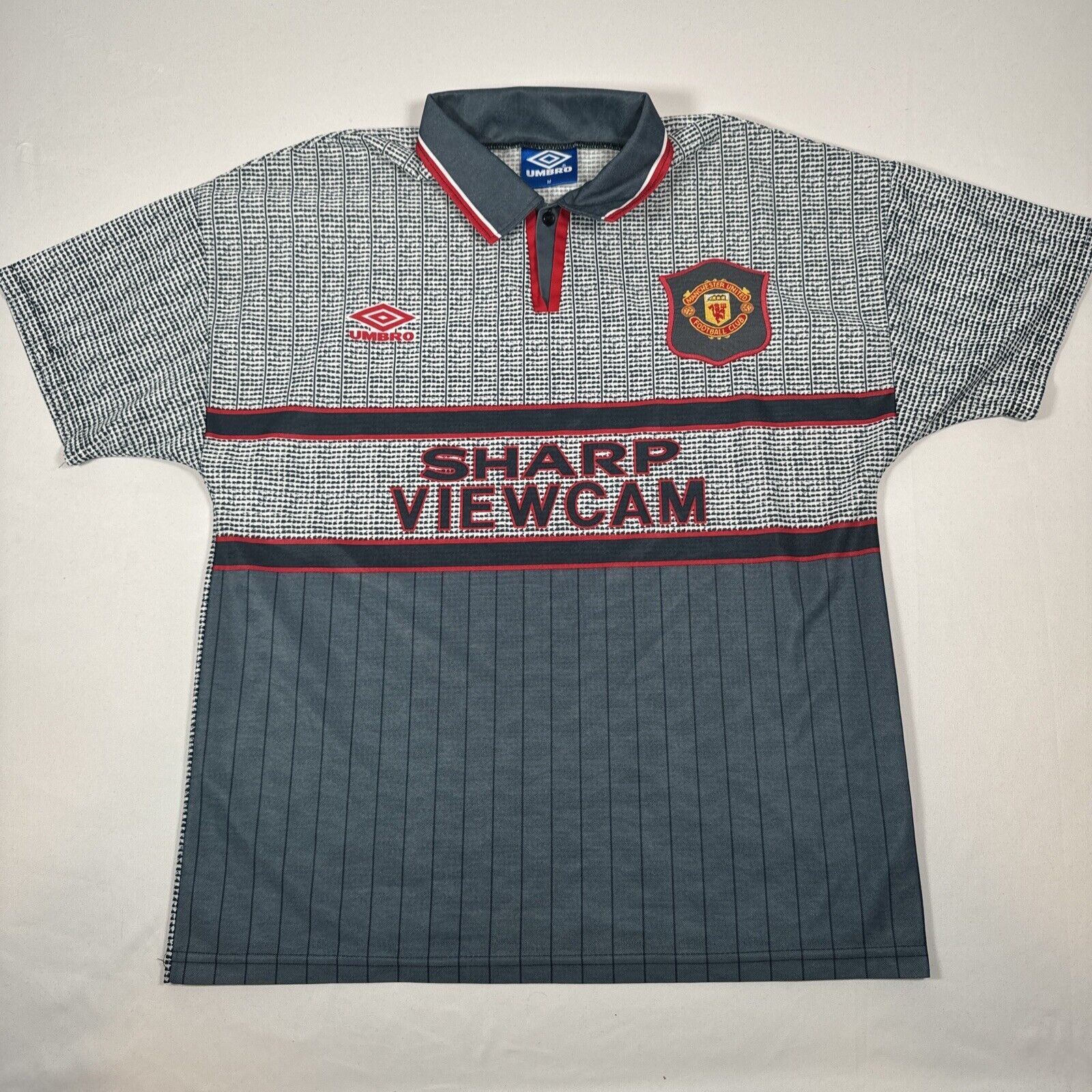
No football shirt has ever been retired at half-time. Not because of a clash with the referee. Not because of a sponsor dispute. Not because it was torn or bloodied. The Manchester United 1995–96 grey away kit was taken off and thrown in a bag at The Dell on 13 April 1996 because the players couldn't see each other. It had been worn for five competitive matches. United lost all five. After Southampton, it was never seen on a pitch again.
The story has become one of football's favourite anecdotes — a punchline about Ferguson's mind games, an excuse for a bad day at the office. But the grey kit was never just a joke. It was a collision of science, superstition, and a title race that a team of teenagers had no business winning.
The season the rules broke
The 1995–96 campaign began with a funeral. In the summer of 1995, Alex Ferguson sold Paul Ince to Inter Milan, Mark Hughes to Chelsea, and Andrei Kanchelskis to Everton — three established internationals, three pillars of the side that had won the Double two seasons earlier. He replaced them with nobody. Instead, he promoted a group of academy graduates the press had already written off: David Beckham, Paul Scholes, Nicky Butt, and the Neville brothers. Alan Hansen's "you can't win anything with kids" would come on the opening day, after a 3–1 defeat at Aston Villa — in the grey kit [1].
What followed was the most improbable title win of the Premier League era. Newcastle United, bankrolled by Sir John Hall and spearheaded by Les Ferdinand and David Ginola, opened a 12-point lead by January. Eric Cantona returned from an eight-month suspension in October and scored 19 goals across all competitions, including the FA Cup final winner against Liverpool [2]. United hunted Newcastle down, won the Double, and made Hansen eat his words. They did it in spite of the grey kit — and in one case, because they stopped wearing it.
The shirt
The shirt itself was not ugly. Designed by Umbro — United's manufacturer since 1992 — the grey away kit featured a subtle geometric shadow pattern across the body, with black collar and sleeve trim and the red-and-white Umbro diamond repeated across the fabric. The Sharp Viewcam logo sat in white on the chest. It was an ambitious design for its time: not the traditional white or blue away strip, but a modern, monochrome look meant to appeal to a new generation of replica-shirt buyers.
There was just one problem, flagged by United's kit man Albert Morgan before the season even started. The Premier League had introduced new regulations limiting the number of manufacturer logos visible on a shirt — a direct response to the logo-heavy designs of the early 1990s. Umbro's original version of the grey shirt featured the diamond logo repeated across the entire garment. Under the new rules, those had to be removed. By the time the shirt reached the players, something about the visual density of the pattern had been stripped away, leaving a fabric that, under floodlights and against a crowd, registered as a haze of nothing [3].
The professor and the eye muscles
Ferguson didn't just hate the shirt because it looked bad. He had the receipts.
Two years earlier, United had employed Professor Gail Stephenson from Liverpool University as an "eye coach." Her work focused on peripheral vision and oculomotor fitness — the ability of the eye muscles to track fast-moving objects against cluttered backgrounds. Stephenson's research, applied to football, suggested that grey was the single worst colour for visual contrast against a crowd. Players in grey shirts would take a fraction of a second longer to identify a teammate in their peripheral vision than players in white or bright colours. In a sport where a through-ball is released in less than a second, that fraction mattered [4].
Gary Neville confirmed years later that the spare kit — the blue-and-white striped third shirt — was already laid out in the away dressing room at The Dell before kick-off. "You don't take another kit to a game unless you're thinking there's a problem with it," Neville told Sky Sports. "Sir Alex had this in his head before the game that this kit was a problem because he'd been told by Gail" [4].
Five games, no victories
The grey kit's full competitive record is a statistical outlier in what was otherwise a championship season:
- 19 August 1995: Aston Villa 3–1 Manchester United (opening day)
- 4 November 1995: Manchester United 0–1 Arsenal (Highbury — the famous Bergkamp goal era was still germinating, but Ian Wright scored the winner)
- 17 December 1995: Liverpool 2–0 Manchester United (Anfield, Robbie Fowler double)
- 1 January 1996: Tottenham 4–1 Manchester United (White Hart Lane, Teddy Sheringham masterclass)
- 13 April 1996: Southampton 3–1 Manchester United (The Dell — kit retired at half-time)
Five defeats, zero draws. United lost at Villa, Arsenal, Liverpool, and Tottenham all while wearing grey. The Southampton match made it five appearances, five defeats, and one match abandoned at the interval [4][5].
At The Dell, United were 3–0 down at half-time. Ken Monkou, Neil Shipperley, and Matt Le Tissier had torn through a defence that included Gary Neville — playing centre-half in the absence of Gary Pallister — and looked, in Neville's own words, "punch-drunk." Ferguson marched into the dressing room and told Morgan to bin the shirts. The players emerged in blue-and-white stripes. They lost the second half 0–0, but the damage was done. Southampton won 3–1. The FA fined United £10,000 for the kit change. United won the league by four points [2][4].
Matt Le Tissier, ever the contrarian, claimed he didn't even notice the change. "I was walking to my car and one of the reporters asked me what I thought about them changing their kit at half-time. I looked at him and went, 'did they?'" [4]. He was being generous. Or mischievous.
What the market says now
The shirt that nobody wanted to see on the pitch is now one of the most sought-after pieces of 1990s football memorabilia. The Kitdex API tracks 37 live listings for the Manchester United 1995–96 Umbro away shirt. The median price across all conditions sits at £124.99, but that number hides a wide spread [6].
A Cantona #7 in 9/10 condition runs around £150–185. A Beckham #24 (his early squad number before switching to 7) in similar condition pushes past £200. At the top end, a BNWT (brand new with tags) specimen is listed at £350 — and it's not the only one. The grey shirt's infamy has made it more valuable, not less, than contemporary United away kits. The 1994–95 black away kit, by comparison, rarely breaks £100 in comparable condition [6].
The irony is complete. Umbro's design failure — a shirt so optically blank that Ferguson's team couldn't find each other on a football pitch — became a collector's grail precisely because of the story attached to it. Nobody buys the 1995–96 grey shirt because they love the look. They buy it because wearing it is a conversation starter. It is the only football shirt whose primary value is narrative, not aesthetics.
The real lesson
The grey kit story is usually told as a Ferguson anecdote: the paranoid genius, the mind games, the world's most expensive excuse for losing at The Dell. But the science behind it was real, and Ferguson's willingness to act on it — to have a spare kit ready in the dressing room, to bin a commercial product in the middle of a title race, to eat the £10,000 fine — reveals something sharper about his management.
In a season defined by marginal calls (selling three stars, trusting children, chasing down a 12-point deficit), the grey kit was another calculation. Ferguson decided that a fraction of a second's delay in peripheral vision was too much to carry into the run-in. A team that had no business winning the league could not afford to lose another game because their shirts blended into the crowd. He was right. After the grey kit was retired, United won their final four matches and lifted the title at the Riverside Stadium in May [2].
The shirt that couldn't be seen ended up being one of the most visible reminders of how fine the margins were.
Sources
- Wikipedia, 1995–96 Manchester United F.C. season — season overview, transfers, league campaign.
- Wikipedia, Manchester United F.C. — "Crest and colours" section, including the grey kit's five-game record and retirement.
- Premier League kit regulation changes, mid-1990s — restrictions on repeated manufacturer logos.
- Gary Neville interview, Sky Sports The Football Show, 14 April 2020 — comments on Professor Gail Stephenson, spare kit in dressing room, Ferguson's pre-match suspicion.
- Match data aggregated from Premier League archives, 1995–96 season — grey kit appearances and results.
- Kitdex API,
manchester-united-1995-96-away— median price £124.99 across 37 listings, market spread from £57 to £350. View on Kitdex