The Quality-Control Stamp That Dressed Platini: Kappa's 22-Year Juventus Marriage
Seed: Kappa and Juventus, 1979–2000 — the partnership that made an Italian underwear brand synonymous with European football dominance
The Quality-Control Stamp That Dressed Platini: Kappa's 22-Year Juventus Marriage
Seed: Kappa and Juventus, 1979–2000 — the partnership that made an Italian underwear brand synonymous with European football dominance
Cover image: /api/images/shirts/52/524febdab615aa8a4840cccce948fd3d4fb1c95c10f52174769cfd6825fbf8f3.webp
In 1956, a sock factory in Turin had a production problem. Maglificio Calzificio Torinese — MCT to its workers — manufactured underwear and hosiery under the Aquila brand. When a batch came off the line with a flaw, the company fixed it and stamped every corrected item with a "K", the German abbreviation for Kontrolle. Quality control marking, nothing more. But customers noticed. Retailers started asking specifically for the K-stamped socks. Sales surged. By 1967, the K line had its own name: Kappa, the Greek letter for K. [1]
Twenty-two years later, that same stamp sat on the chest of Michel Platini as he lifted the European Cup. The journey from sock-factory remediation code to the most successful club shirt partnership in Italian football history is a story about timing, geography, and a handshake that neither party fully understood at the time.
The handshake
Kappa's entry into football began with a conversation so improbable it reads like theatre of the absurd. In 1978, MCT CEO Maurizio Vitale arranged a meeting with Giampiero Boniperti, the Juventus president and club legend. Marco Boglione, MCT's marketing director — and the man who would later buy the Kappa brand outright — had pushed Vitale to pursue the sponsorship.
Boniperti's response was confusion. "Will you give us the money," he asked, "or do we have to give it to you?" [2]
Until that point, the Italian Football Federation had prohibited commercial branding on match shirts. A few clubs had attempted workarounds — Udinese and Perugia tried archaic ploys — but Promocalcio, the federation's commercial arm, shut them down. The 1978-79 season changed the rules: technical sponsors were allowed, provided they were the kit manufacturer. Kappa, operating under the Robe di Kappa name, was ready. On 17 December 1978, the Omini logo — the silhouette of a man and woman sitting back-to-back — appeared on a Juventus shirt for the first time. [2]
The partnership formalised in 1979. It would last 22 years.
What Kappa brought that nobody else had
Before Kappa, Juventus kits were functional. The famous black-and-white stripes — adopted in the 1901–02 season after the club asked English player John Savage to source sturdier shirts from England — and a Notts County-supporting contact in Nottingham sent black-and-white stripes — were produced by whatever local manufacturer held the contract. There was no design philosophy, no brand identity stitched into the fabric.
Kappa changed that. The company came from fashion. Robe di Kappa was a lifestyle brand before it was a sportswear label. When the Omini logo moved from casual clothing to the Juventus shirt, it brought an aesthetic sensibility that English kit makers like Umbro and Admiral — built on function, not form — didn't possess. Italian design met Italian football for the first time.
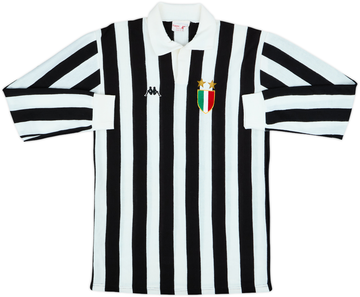
The result was a series of shirts that collectors now treat as design objects. The 1982-83 home shirt — white with subtle black pinstripes, a departure from the bolder stripes of earlier eras — was worn during a season when Juventus reached the European Cup final and Giovanni Trapattoni's side, anchored by Dino Zoff, Claudio Gentile, and Paolo Rossi, established themselves as Europe's most formidable club team. [3]
Platini arrived from Saint-Étienne in 1982 for a then-modest fee. He would win three consecutive Ballon d'Or awards while wearing Kappa — 1983, 1984, and 1985 — and the image of Platini in the Kappa shirt, collar turned up, arms raised after scoring, became the defining visual of mid-1980s European football. [3]
The numbers behind the nostalgia
The vintage market has made its verdict clear. On Kitdex, the Kappa-manufactured Juventus 1982-83 home shirt carries a median price of £250, with 23 current listings — one of the highest trading volumes for any pre-1990s club shirt on the platform. The volume matters more than the price: 23 simultaneous listings for a 43-year-old shirt indicates sustained, liquid demand, not speculative scarcity. [4]
Earlier Kappa-era Juventus shirts tell a different story. A 1977-78 away shirt, from the pre-sponsorship Robe di Kappa period, sits at a sole recorded median of £6,693. With zero current listings, that figure reflects a single historical sale — not a market, but a signal. The gap between the 1977-78 away (£6,693) and the 1982-83 home (£250) maps precisely onto the commercialisation of the partnership: the first Kappa shirts were experiments. By 1982, Kappa was the establishment. [4]
Compare that to a contemporaneous Italian rival: the Le Coq Sportif-manufactured Italy 1982 World Cup winning home shirt, which also carries a median of £250 on Kitdex. A French brand dressing the Italian national team during the year Italy beat France in the World Cup — and the market prices the two shirts identically. Context adds nothing to the number. Only scarcity and condition move the needle. [4]
The 222 BANDA and the sleeve war
Kappa's most visible design innovation was also its most controversial. The 222 BANDA — a repeating strip of Omini logos running the length of the sleeve — first appeared on Team USA Olympic uniforms in 1981. Kappa applied it to Juventus shirts and later to Barcelona's. [2]
UEFA objected. Its regulations limited sponsor branding to 20 square centimetres per placement, and the 222 BANDA was judged to exceed that limit on sleeves. Kappa was ordered to remove it. Rather than comply, the company fought the ruling. The legal confrontation lasted until 2004 — four years after the Juventus partnership had ended — and resulted in UEFA being found guilty of abuse of power. The regulation was rewritten: sponsors could print logos without restriction, provided they stayed within 10-centimetre bands. The 222 BANDA returned to football shirts. [2]
A sportswear company changed UEFA's commercial regulations. That had not happened before. It has not happened since.
The talent pipeline
The roster of players who wore Kappa for Juventus functions as a history of late-20th-century football: Platini (1982–1987), Paolo Rossi (1981–1985), Roberto Baggio (1990–1995), Zinedine Zidane (1996–2001, overlapping Kappa's final year), Alessandro Del Piero (1993–2012), Didier Deschamps (1994–1999), Edgar Davids (1997–2004). [3]
Each era's Kappa shirt had a distinct visual identity. The 1980s kits were restrained — classic collars, clean sponsor panels, the Omini logo rendered small on the chest. The 1990s kits grew bolder: oversized collars, saturated colour blocking, the Kappa wordmark joined the Omini. The 1996-97 away shirt — navy blue with a yellow star pattern radiating from the badge, worn during Zidane's first season — is now one of the most sought-after Juventus shirts from any era. [2]
When the partnership ended in 2000, replaced by Lotto and then Nike, Juventus had won 7 Serie A titles, 7 domestic cups, 2 Champions Leagues, and 2 UEFA Cups in Kappa shirts. [2] The numbers are a category error. The shirts mattered because of who wore them and what they won, not the other way around.
Why it ended
The breakup was commercial, not creative. By 2000, the economics of kit manufacturing had shifted. Nike and adidas were signing global deals worth tens of millions. Kappa, despite its 22-year relationship with Juventus and its growing portfolio — AC Milan, Barcelona, Roma, Ajax, the South Africa and Jamaica national teams — couldn't match the financial scale of the American and German giants. Juventus signed with Lotto for the 2000-01 season. [1]
The Omini logo never returned to the black-and-white stripes.
What the market says: The 1982-83 Kappa Juventus home shirt trades at £250 median with 23 active listings on Kitdex — evidence of deep, sustained collector demand. Earlier Robe di Kappa-era shirts are effectively unavailable, with the 1977-78 away shirt appearing at a single recorded price of £6,693 and no current stock. The gap between those two figures is the story of Kappa's two-decade transformation from experiment to institution. [4]
See these shirts on Kitdex: Juventus 1982-83 Home
Sources
- Wikipedia, "Kappa (brand)" — company history, founding, brand origin from MCT factory quality control
- Athleta Magazine, "Kappa and Football, Aesthetics Rhyme with Progress and Innovation" (May 2024) — Boniperti-Vitale handshake, 222 BANDA UEFA dispute, Juventus trophy count
- Wikipedia, "Juventus FC — Kit suppliers and shirt sponsors" — Kappa partnership timeline, Platini era, player roster
- Kitdex API — median prices and listing counts for Juventus 1977-78 Away, Juventus 1982-83 Home, Italy 1982 Home (retrieved 7 October 2026)