The Purple Pixel: When Nintendo Sponsored Fiorentina
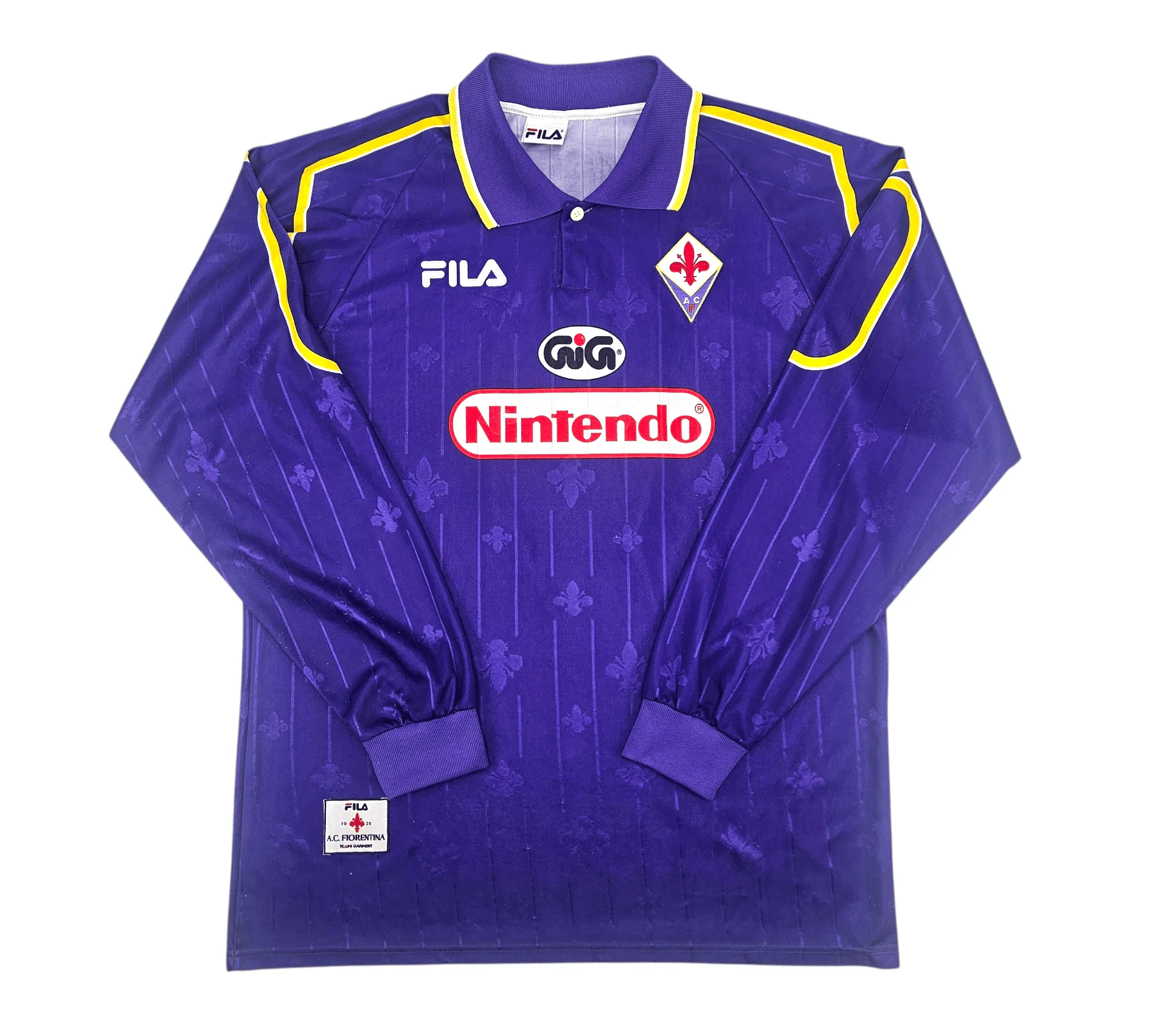
The shirt in question: Fiorentina 1997-98 Home — Fila-manufactured, Nintendo-sponsored, Batistuta era.
The Purple Pixel: When Nintendo Sponsored Fiorentina
The shirt in question: Fiorentina 1997-98 Home — Fila-manufactured, Nintendo-sponsored, Batistuta era.
The Purple Pixel: When Nintendo Sponsored Fiorentina
In the summer of 1997, Nintendo of Europe made a decision that would become one of the strangest and most beloved footnotes in football kit history. It signed a deal to place its logo — the red-and-white racetrack oval known to every child who had ever held a Game Boy — across the chest of ACF Fiorentina. For two seasons, the Japanese video game giant sat above the heart of the purple shirts worn by Gabriel Batistuta in Florence's Stadio Artemio Franchi. It should not have worked. It worked perfectly.
The sponsorship arrived at a precise cultural intersection. Serie A in the late 1990s was the richest, most-watched league in the world, a destination for the planet's best footballers. Nintendo was near the peak of its cultural dominance, with the Nintendo 64 having launched across Europe in March 1997 and Pokémon about to ignite a global phenomenon. And Fiorentina, under the ownership of film producer Vittorio Cecchi Gori, was building a team that would push for the Serie A title and reach the Champions League [1].
The Cecchi Gori dream
Cecchi Gori had inherited the club from his father Mario in 1993, and his tenure was defined by ambition that consistently outran the balance sheet. He kept Gabriel Batistuta — the Argentine striker who had stayed with the club through relegation to Serie B in 1993 — and built around him. Rui Costa arrived from Benfica in 1994. The purple shirts won the Coppa Italia in 1996 and the Supercoppa Italiana by beating Milan at the San Siro. They reached the Cup Winners' Cup semi-final in 1997, losing to the eventual winners Barcelona [1].
By the time Nintendo's logo appeared for the 1997-98 season, Fiorentina was a serious team playing serious football. The shirts were made by Fila, the Italian sportswear brand whose football division was hitting its stride. Fila had inherited the kit contract and delivered two distinct designs over the Nintendo years: the 1997-98 home shirt featured yellow trim on the collar and cuffs, while the 1998-99 version switched to a white collar and added the club's centenary crest. Both carried the Nintendo logo in its unmistakable red framing on the deep Fiorentina purple.
Why Nintendo?
The deal made little commercial sense by modern sponsorship logic. Nintendo was not selling football games — its core business was handheld consoles and home entertainment systems. There was no obvious demographic crossover between Serie A viewers and Game Boy owners. The partnership was brokered by Nintendo of Europe's Italian office, reportedly driven more by the personal enthusiasm of executives than any spreadsheet analysis. It was, in retrospect, a deal from a different era: before sponsorships became algorithmic placements, when a logo could appear on a shirt simply because someone thought it would look good there [6].
The 1997-98 season was solid if unspectacular. Under coach Alberto Malesani, Fiorentina qualified for the UEFA Cup but struggled for consistency against smaller sides. Malesani departed after one season. What followed, in 1998-99, was the shirt's true stage [1].
The Trapattoni season
Cecchi Gori appointed Giovanni Trapattoni — the most decorated Italian coach of the era, with seven Serie A titles across spells at Juventus and Inter — to take over in the summer of 1998. Trapattoni's Fiorentina, with Batistuta leading the line and Rui Costa pulling the strings behind him, mounted a genuine title challenge. Batistuta scored 21 league goals. The team finished third in Serie A, their best league finish since 1984, and qualified for the Champions League for the first time in the club's history [1].
The image of Batistuta in the purple Nintendo-sponsored Fila shirt, arms outstretched after another thunderous finish, became one of the defining visual signatures of late-1990s Italian football. He was arguably the best pure striker in the world at that moment, and the shirt he wore looked like nothing else in the sport. Purple was rare enough. Purple with a video game logo was unique.
The 1998-99 shirt was also worn by a supporting cast that included the Brazilian Edmundo, the Belgian Luis Oliveira, and the German Jörg Heinrich — a squad assembled with Cecchi Gori's characteristic mix of star power and financial brinkmanship that would soon prove unsustainable.
The afterglow
Nintendo's sponsorship ended after the 1998-99 season. Fila remained as kit supplier for 1999-2000 before Diadora took over. Batistuta was sold to Roma in the summer of 2000, where he immediately won the Scudetto that had eluded him in Florence. Fiorentina, burdened by debts estimated at $50 million, went into bankruptcy in 2002 and was re-founded in the fourth tier of Italian football [1].
The Nintendo shirt became something more valuable than commercial merchandise: it became a time capsule. It contained the final flourishing of the Cecchi Gori project, the peak of Batistuta's powers, the last moment before financial reality arrived. And it contained the Nintendo logo — a detail that made the shirt unmistakably, irretrievably 1997.
The market today
The Fiorentina-Nintendo shirts are among the most sought-after vintage football shirts on the market — and among the most counterfeited. The Football Shirt Collective has published detailed authentication guides, noting that the Fila labels, the Nintendo logo positioning, and the collar construction are all frequent points of failure on fakes [2].
The Kitdex marketplace reflects the demand. The 1997-98 Fiorentina home shirt has recorded sales from €249 to €480 across tracked platforms, with current listings concentrated in the £300-500 range depending on condition and size [3]. The 1999-2000 Fila away shirt, the last of the Fila era, has active listings at £300-350 in excellent condition [4]. A goalkeeper variant from the 1997-98 season recorded a single market snapshot at €799 [5]. These are not the most expensive vintage shirts on the market — a match-worn Batistuta example with the Nintendo sponsor would command significantly more — but they represent consistent, durable demand.
What is striking about the data is not the absolute prices but the trajectory. The market snapshots for the 1997-98 home shirt show a steady upward movement from €249 to €480 over the tracking period, with demand rooted in the shirt's cultural cachet rather than trophy association. This is a shirt people want because of what it represents, not what it won.
One listing on the Kitdex API for the 1997-98 home shirt is priced at over €1 million — an outlier that likely reflects either an error, a test listing, or a seller making a statement rather than a serious offer [3]. Excluding that, the realistic market range runs from roughly €250 for a worn example in average condition to €500-600 for a pristine piece.
What the shirt means
The Nintendo-Fila shirt endures because it is a genuine artifact rather than a calculated product. No marketing department would greenlight it today. The modern sponsorship landscape is dominated by airlines, betting companies, and cryptocurrency exchanges — industries that treat shirt placement as a line item in a global media budget. The idea of a Japanese video game company sponsoring a mid-sized Italian club because someone in the Rome office thought it might be fun belongs to a lost world.
That world was the 1990s, when Serie A was the epicentre of football culture and its shirts reflected a kind of chaotic, unmediated internationalism. Mars chocolate bars on Napoli. Parmalat dairy on Parma. Nintendo on Fiorentina. These were not brand alignment strategies. They were moments of genuine cultural collision, and the shirts they produced are now treasured precisely because the logic behind them is unrepeatable.
The Fiorentina-Nintendo shirt is not the most valuable vintage kit on the market. It is, however, one of the most perfectly of-its-time objects in football history — a purple rectangle of polyester and corporate logos that somehow sums up an era more accurately than any trophy or transfer fee ever could.
Sources
- Wikipedia, "ACF Fiorentina — Cecchi Gori era: from Champions League to bankruptcy." https://en.wikipedia.org/wiki/ACF_Fiorentina
- Football Shirt Collective, "How to spot a fake 1998 Fiorentina shirt." https://footballshirtcollective.com/blogs/collectors-club/how-to-spot-a-fake-1998-fiorentina-shirt
- Kitdex API, "Fiorentina 1997-98 Home." https://kitdex.app/shirt/fiorentina-1997-98-home
- Kitdex API, "Fiorentina 1999-00 Away." https://kitdex.app/shirt/fiorentina-1999-00-away
- Kitdex API, "Fiorentina 1997-98 GK." https://kitdex.app/shirt/fiorentina-1997-98-gk
- nss sports, "The 15 Most Iconic Sponsors in Football History." https://www.nss-sports.com/en/lifestyle/14905/iconic-sponsor