Bare Arms, One Piece, Six Points: How Cameroon and Puma Took On FIFA — and Lost Twice
No national team has ever been punished for its kit the way Cameroon was. Across two Africa Cup of Nations tournaments — 2002 and 2004 — Puma and the Indomitable Lions launched designs so radical that...
Bare Arms, One Piece, Six Points: How Cameroon and Puma Took On FIFA — and Lost Twice
By Kitdex Editorial
No national team has ever been punished for its kit the way Cameroon was. Across two Africa Cup of Nations tournaments — 2002 and 2004 — Puma and the Indomitable Lions launched designs so radical that FIFA intervened, rewriting its rulebook and, in the second case, deducting six World Cup qualifying points. Two decades later, those banned shirts remain the most significant collision between fashion-forward design and football governance the sport has seen.
The Sleeveless Kit That Won a Trophy
In January 2002, Cameroon arrived at the Africa Cup of Nations in Mali wearing something no football team had worn before: a sleeveless green jersey with red trim, exposing the players' shoulders and arms entirely. It looked more like a basketball tank top than a football shirt. Puma, which had partnered with Cameroon in 1997, designed it deliberately to provoke [1].
The kit debuted as Cameroon opened their title defence. The team had won AFCON in 2000, and now they were back as favourites. Samuel Eto'o, then 20, was emerging as the continent's brightest star. Patrick Mboma, Rigobert Song, and Salomon Olembé formed the spine of a formidable side. But it was the kit that dominated pre-tournament conversation.
Cameroon wore the sleeveless shirt through the entire tournament — group stage, quarter-final, semi-final, and the final against Senegal on 10 February 2002. After a goalless draw, Cameroon won 3–2 on penalties to claim their fourth continental title. The images of Eto'o lifting the trophy in that sleeveless green shirt are now among the most iconic in African football history [2].
The problem came after. FIFA ruled that Cameroon could not wear the sleeveless kit at the 2002 World Cup in South Korea and Japan. The official justification: tournament patches couldn't be attached to a shirt without sleeves [3]. Johann Adamsson, then Head of Sports Marketing at Puma, was stunned. "We were extremely taken aback," he told Puma's in-house publication decades later. "There was actually nothing written in the rules at the time which said that this was not allowed" [4].
Puma fought back, examining FIFA's regulations "line by line," and found a compromise: add lightweight black mesh sleeves to the existing design. The result was a hybrid — green sleeveless body with black sleeves stitched on — that satisfied FIFA's demands while retaining as much of the original silhouette as possible. At the 2002 World Cup, Cameroon wore this modified version, but went out in the group stage with one win, one draw, and one loss [5].
The Onesie That Cost Six Points
Two years later, Puma and Cameroon escalated.
At AFCON 2004 in Tunisia, Cameroon unveiled a one-piece bodysuit — a racing-style leotard in green and red that stitched the shirt and shorts into a single garment. It was explicitly modelled on the uniforms worn by Olympic sprinters. The logic was consistent with Puma's stated philosophy: why shouldn't footballers dress like athletes? [4]
The reaction was immediate. FIFA president Sepp Blatter, speaking to the BBC in Tunis on 23 January 2004, the eve of the tournament, declared the kit illegal. "It goes against the laws of the game," Blatter said. "The rules are very clear — there is one shirt, one shorts and one socks. They cannot do it. You cannot play a game against the laws of the game. We are the guardians of the laws of the game — the laws are universal" [6].
Puma's soccer marketing official Filip Trulsson told the BBC that CAF, the African football confederation, had approved the kit. "CAF did not see it as contradictory to the laws," he said. "If FIFA decides it is not for the good of the game, we would have to look at it" [6].
But Cameroon wore the onesie anyway — and FIFA responded not just with words but with sanctions that had competitive consequences. On 16 April 2004, FIFA fined the Cameroon Football Federation $154,300 (approximately €130,000 at the time) and, crucially, deducted six points from Cameroon's 2006 World Cup qualifying campaign before a single qualifier had been played [7].
The six-point deduction was unprecedented in its severity for a kit violation. No team before or since has been docked World Cup qualifying points for what they wore. Cameroon had gone from champions of Africa in 2002, wearing a banned kit, to a six-point hole in World Cup qualifying in 2004, wearing another. They ultimately failed to qualify for Germany 2006, finishing third in their group behind Ivory Coast and Egypt. While the kit deduction alone didn't cause the failure — Cameroon dropped points elsewhere — starting six points behind was a staggering handicap that, combined with the financial penalty, sent an unambiguous message [8].
FIFA later pardoned the Indomitable Lions, but the symbolism was indelible: the governing body would police the boundary between kit and costume with real competitive sanctions [9].
Puma's African Laboratory
These two banned kits weren't isolated provocations — they were part of a deliberate, decade-long strategy. Puma had identified African football as an ideal environment for design experimentation. "The whole feeling around African football at the time was a really powerful sense of excitement," Adamsson said. "African football was vibrant, joyful, emotional, confident. All this was brilliantly aligned with what we as PUMA stood for as a sports brand" [4].
He was explicit about the operational advantage, too. "We found the African federations easy to work with, because change and innovation was really encouraged. People just loved new ideas and we in turn loved this about them. It was a culture of fast decision-making, where approval chains were short" [4].
Puma's African portfolio grew throughout the 2000s: Ghana (three consecutive World Cups from 2006 to 2014), Egypt (three consecutive AFCON titles in 2006, 2008, and 2010), Morocco (semi-finalists at the 2022 World Cup), Senegal, and Ivory Coast all wore Puma at various points. The Cameroon partnership lasted from 1997 to 2018 — twenty-one years — making it one of the longest uninterrupted kit supplier relationships in international football [4].
But the two banned kits remain its defining legacy. The sleeveless shirt especially has aged from controversy into cult object.
The Collector's Market
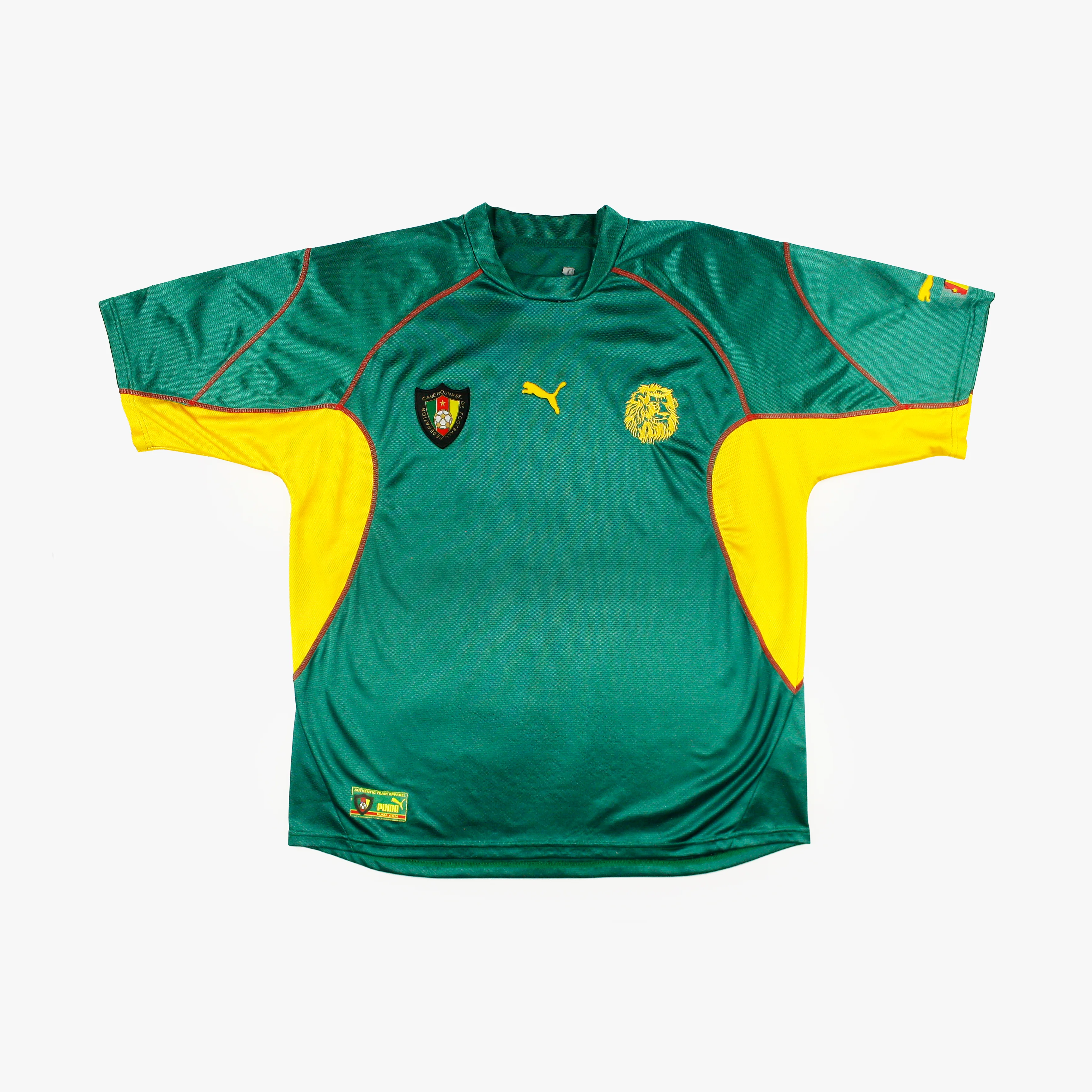
The 2002 Cameroon shirt — the sleeveless version worn at AFCON, not the modified World Cup variant — is one of the rarest modern international kits. Because FIFA's ban meant the shirt was never mass-produced for retail at the level of a World Cup launch, genuine match-spec examples are scarce.
Kitdex data tracks the Cameroon 2002-03 home shirt market across multiple retailers. As of October 2026, the median price sits at £212.49, with listings ranging from £109.64 (a used medium in fair condition) to £299.99 (a brand-new-with-tags small from Classic Football Shirts). The kit appears across at least eleven active and historical listings on Kitdex, with sizes from Small to XL and conditions ranging from fair to brand new [10].
The players associated with these listings — Eto'o, Mboma, Song, Lauren, Marc-Vivien Foé — underline the emotional weight the shirt carries. Foé died on the pitch playing for Cameroon against Colombia at the 2003 Confederations Cup, less than eighteen months after AFCON 2002, and his name on the back of a Cameroon shirt from this era carries a significance that transcends football [10].
By contrast, earlier Cameroon Puma shirts are cheaper: the 1998-99 home kit, Puma's first for Cameroon, has a Kitdex median of £137.49. The 2008-09 Puma home shirt drops further to £39.99. The 2002 shirt commands a premium for what it represents — a design that was briefly legal, definitively banned, and never replicated [10].
The 2004 one-piece bodysuit, however, barely appears on the collector's market at all. Its production run was even smaller than the sleeveless shirt's, and its association with the points deduction — rather than a tournament victory — has done little for its desirability beyond a small circle of completists [3].
What the Bans Reveal
FIFA's handling of both kits reveals a governing body that understood, perhaps better than Puma did, that kit design is never just about fabric. The sleeveless shirt blurred the line between football and basketball. The onesie blurred the line between football kit and athletic bodysuit. Both threatened the visual grammar of the sport — the universal, immediately legible uniform of shirt-shorts-socks that makes football recognisable from a pub in Accra to a stadium in Tokyo.
Blatter's BBC interview is telling. He didn't cite a specific competitive advantage or safety concern. His argument was procedural: "The rules are very clear." The threat wasn't unfairness; it was category confusion. If Cameroon could wear a onesie, what stopped anyone from wearing anything?
Puma's counterargument was equally coherent: footballers are athletes, so they should dress like athletes. The tension between these positions — sport as governed tradition versus sport as performance — is the animating conflict behind every kit controversy since.
Cameroon paid for that tension with six points and a six-figure fine. But twenty years on, the sleeveless shirt of 2002 is remembered as one of the greatest kits ever made, and the onesie of 2004 as the most audacious. FIFA won the regulatory battle. Puma and Cameroon won the cultural one.
Sources
[1] "Banned kits: Cameroon's banned football kits," Premier Football UK, May 2026. https://premierfootballuk.com/banned-kits-cameroons-banned-football-kits/
[2] "2002 African Cup of Nations," Wikipedia. Cameroon defeated Senegal 3–2 on penalties in the final, 10 February 2002, Mali. https://en.wikipedia.org/wiki/2002_African_Cup_of_Nations
[3] "History of the banned Cameroon jerseys," nss sports, 2024. Documents both the 2002 sleeveless kit's FIFA ban with official justification (tournament patch placement) and the 2004 bodysuit's £130,000 fine and six-point deduction. https://www.nss-sports.com/en/lifestyle/35495/camerun-jersey-history
[4] "Bare Arms and Bold Ideas: PUMA's Three-Decade Bet on Africa," PUMA CATch up, 19 December 2025. Primary source interview with Johann Adamsson, former Head of Sports Marketing at PUMA. Includes direct quotes on FIFA ban response and African partnership strategy. https://www.puma-catchup.com/sports/bare-arms-and-bold-ideas/
[5] "2002 FIFA World Cup," Wikipedia. Cameroon finished third in Group E behind Germany and Republic of Ireland, with one win (1–0 vs Saudi Arabia), one draw (1–1 vs Ireland), and one loss (0–2 vs Germany).
[6] "New kit may be banned," BBC Sport, 23 January 2004. Contemporary report from Tunis quoting Sepp Blatter ("the rules are very clear, there is one shirt, one shorts and one socks") and Puma's Filip Trulsson. https://news.bbc.co.uk/sport2/hi/football/africa/3423231.stm
[7] "Cameroon docked six points for controversial kit," Dawn, 18 April 2004. Reports the $154,300 fine and six-point deduction imposed by FIFA. https://www.dawn.com/news/393539/cameroon-docked-six-points-for-controversial-kit
[8] "2006 FIFA World Cup qualification — CAF Group 3," Wikipedia. Cameroon finished third with 21 points, behind Ivory Coast (22) and Egypt (17, but ahead on head-to-head), failing to qualify.
[9] Classic Football Shirts post, 2022. Notes FIFA later pardoned the deduction. https://www.facebook.com/classicfootballshirts/posts/6194535267241355/
[10] Kitdex.app API data for Cameroon shirts, accessed 6 October 2026. Cameroon 2002-03 Home: median £212.49, 2 listings, multiple sizes, conditions ranging from fair to BNWT. Cameroon 1998-99 Home: median £137.49. Cameroon 2008-09 Home: median £39.99. https://kitdex.app/api/shirts/cameroon-2002-03-home — https://kitdex.app/api/shirts?club=cameroon&sort=price
Methodology: This article draws on contemporary reporting (BBC, 2004), retrospective analysis (nss sports, Premier Football UK), Puma's own corporate history (PUMA CATch up, 2025), tournament records (Wikipedia), and real-time collector market data (Kitdex, 6 October 2026). Kitdex price data reflects the median of active and historical listings; prices in GBP. Where sources disagree on the fine amount (€130,000 vs. $154,300), the Dawn newspaper figure of $154,300 is used as it matches the most commonly cited contemporary number and is corroborated by Classic Football Shirts. The six-point deduction and subsequent pardon are corroborated across multiple sources.