The Shirt Born From a National Trauma
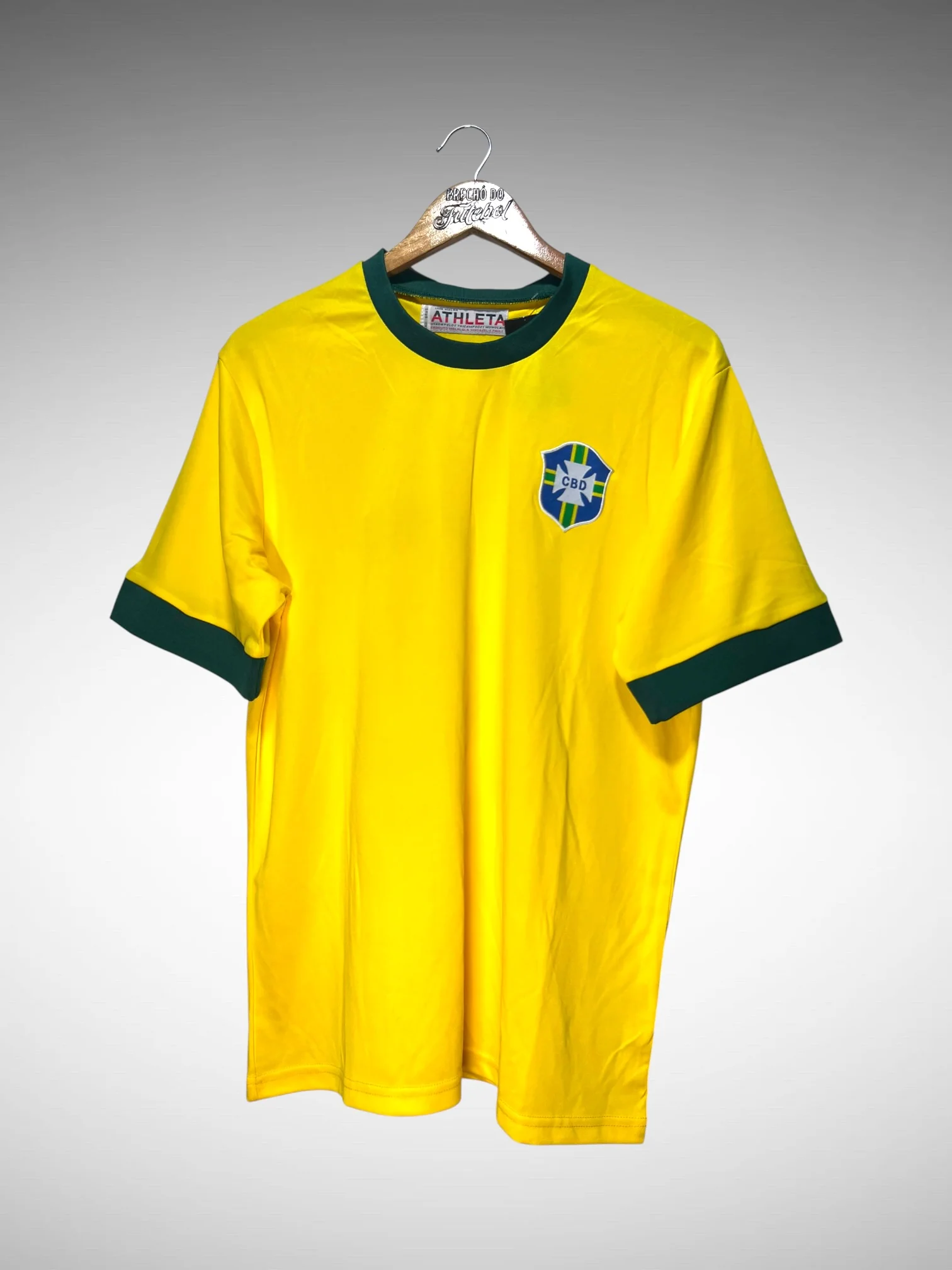
The shirt in question: Brasil 1970 Home — the yellow that replaced the white.
The Shirt Born From a National Trauma
The shirt in question: Brasil 1970 Home — the yellow that replaced the white.
Seed: Brazil's switch from white to yellow after the 1950 Maracanazo, and Aldyr Garcia Schlee, the 19-year-old who designed the canarinho
Cover image: /api/images/shirts/bf/bf8044667e555804e64b2cb8a98d5d48979920ed2b4c610833c327917bdf0e5b.webp
On 16 July 1950, roughly 200,000 people crammed into Rio de Janeiro's Maracanã Stadium. Brazil needed only a draw against Uruguay to win their first World Cup on home soil. The front page of the newspaper O Mundo had already been printed: "Brazil — World Champions." The team walked out in white shirts with blue collars. When Friaça scored in the 47th minute, the stadium erupted. Brazil were 1–0 up. The trophy was theirs.
Eleven minutes from time, Alcides Ghiggia scored Uruguay's winner. The Maracanã fell silent. Brazil had lost 2–1. [1]
The white shirt was blamed. Not the tactics. Not the defending. The shirt. Within three years, the Brazilian Sports Confederation (CBD) partnered with the Rio newspaper Correio da Manhã to launch a national competition: design a new kit for the national team. The only rule was that it must use all four colours of the Brazilian flag — green, yellow, blue, and white. The white shirt, the argument went, carried no sense of Brazilian identity. Argentina wore white and blue stripes. Uruguay wore sky blue. Brazil needed something unmistakably its own. [2]
More than 300 entries arrived. The winner was a 19-year-old newspaper illustrator named Aldyr Garcia Schlee, from Pelotas, a small town in Rio Grande do Sul, right on the border with Uruguay. He had never designed a football kit. He entered the competition "for a bit of fun." [3]
The boy on the border
Schlee grew up straddling two cultures. He was Brazilian, but he lived so close to Uruguay that he trained his drawing skills in the stands of Uruguayan football matches, sketching goal sequences in the style of the Montevideo papers. He cried at the Uruguayan national anthem, not the Brazilian one. When Ghiggia scored in 1950, the 15-year-old Schlee felt the same devastation as every Brazilian — but he also understood what the moment meant for the country across the river. [3] [4]
The competition rules looked simple on paper: use green, yellow, blue, and white. In practice, it was almost impossible. "I was scandalized," Schlee recalled. "Up to three colours, okay. But with four it gets really difficult. No team uses four colours. And the four colours of the flag together do not match much. How can you combine yellow and white on a shirt? It ends up with the national colours of the Holy See!" [2]
He made over 100 drawings. He tried two horizontal bands crossed with an X. He tried a V-shape like Vélez Sarsfield's. Every combination fought itself. Eventually he reached a conclusion: the shirt had to be all yellow. Blue and white went into the shorts. Green was reduced to trim around the collar and cuffs. The socks stayed white. [2]
When Schlee painted the final version, he used whatever colours he had at hand. The yellow came out slightly gold. The blue came out cobalt — not quite the exact shade of the flag, but close enough. Both were accepted. Both remain in the shirt to this day. [2]
His prizes, in today's money, totalled about £6,200 in cash. He also got an apprenticeship at the newspaper, a lifetime seat at the Maracanã, and the chance to present the new strip to five Brazil stars: Pinheiro, Rubens, Ademir, Zizinho, and Nilton Santos. Meeting his idols made him nervous. Zizinho leaned in and whispered: "Don't worry, all this is bullshit." It was Schlee's first lesson in football marketing. [3]
The debut
Brazil wore the yellow shirt for the first time on 14 March 1954, in a friendly against Chile at the Maracanã. They won 1–0. Later that year, they wore it at the World Cup in Switzerland, where they were knocked out in the quarter-finals by Hungary in the infamous "Battle of Berne." Schlee assumed the new kit would be scrapped after elimination. It wasn't. [3] [5]
Four years later, in Sweden, a 17-year-old Pelé scored a hat-trick in the semi-final and two more in the final. Brazil won their first World Cup. The yellow shirt — now called the canarinho, or "little canary" — had its first immortal moment. It would go on to witness four more World Cup triumphs: 1962, 1970, 1994, and 2002. No shirt in football history has won more. [5]
The irony is that Schlee remained a Uruguay supporter his entire life. He never pretended otherwise. In 2015, aged 81, he attended a Brazil-Uruguay match in Montevideo and wept during the Uruguayan anthem. He died on 16 November 2018 — the same day Brazil played Uruguay in a friendly in London. Both teams observed a minute of silence. [5]
The market today
Kitdex tracks Brazil national team shirts across every era from the 1950s to the present. The market reveals an interesting split: earlier shirts are scarcer and more expensive, but the 1970 edition — the one Pelé immortalised in Mexico — records the most intriguing numbers on the platform.
The 1970 home shirt, the canarinho at its absolute peak, has a sole recorded market price of £12.89. It is currently sold out at every tracked retailer. [6] This is almost certainly because surviving originals from 1970 are museum-grade artifacts, while the market data captures modern reproductions. A genuine 1970 match shirt worn by Pelé sold at auction in 2002 for £157,750 — roughly 12,000 times the Kitdex-recorded price. [7]
The 1962 home shirt, from Brazil's second World Cup win — their first successful defence of the yellow jersey — sits at £80.00 with no current listings. The 1978-79 home shirt, from an era when the design had fully matured into the classic yellow-green-blue formula, is priced at £299.99 with one active listing. [6]
Move into the 1980s and the prices climb meaningfully. The 1981 Special — a rare home shirt from the pre-Topper era — has a median recorded at £454.05 with one live listing at £499.00. The 1982-83 home shirt, from the Zico-Sócrates-Falcão generation widely considered the greatest team never to win a World Cup, has the most active market of any vintage Brazil shirt on Kitdex: seven listings at a median of £174.99. [6] This is the shirt that collectors gravitate toward — a design from a team that played football so beautiful the shirt itself became a proxy for the artistry.
The most expensive Brazil shirt on Kitdex is the 1990 Special: a matchworn away shirt worn by midfielder Neto in a post-World Cup friendly against Spain. Priced at £864,113.00 with a single listing, it demonstrates how match-worn provenance — especially with a documented player and match — can multiply a shirt's value by orders of magnitude. Neto wore the number 10 that day. [6]
Matchworn shirts from the late 1980s occasionally surface in the market — a 1987 home shirt linked to the Pelé Cup has appeared with reported sales around £450, though listings are inconsistent. For serious Brazil collectors, documented match-worn provenance from this era is rare and commands a premium when verified. [6]
What the canarinho became
The yellow shirt long ago outgrew football. It is the most instantly recognisable national garment on Earth — ahead of the Scottish kilt, the Indian sari, the Japanese kimono. It has been worn by presidents, protestors, pop stars, and billions of people who have never watched a full 90 minutes of football.
In recent years, the shirt has been politicised in ways Schlee never intended. During Brazil's political crises of the 2010s, the yellow jersey became a uniform of right-wing protest — appropriated by supporters of Jair Bolsonaro in a way that distressed Schlee's family. His son, Aldyr Rosenthal Schlee, told Global Voices: "My father — politically, obviously — would never have sided with the people who have been wearing this shirt lately." Schlee was a pro-democracy activist who was detained and investigated by Brazil's military dictatorship in the 1960s and 1970s for teaching texts about constitutional rights. [4]
The shirt he designed was meant to unite a grieving nation. Seventy years later, it carries more weight than any piece of sportswear should have to bear.
Schlee himself never saw it as the most important thing he did. He became a writer, twice winning the Bienale of Brazilian Literature. He founded a university department and a newspaper. The shirt was one drawing among more than a hundred, submitted on a whim, coloured with whatever paints were on his desk.
But that drawing turned a national trauma into a national symbol. Every yellow shirt worn since — from Pelé's 1958 final to the Maracanã's terraces today — traces back to a teenager in Pelotas who couldn't make four colours sit comfortably together, and solved the problem by making one of them everything.
Sources
- Wikipedia — "Uruguay v Brazil (1950 FIFA World Cup)." The Maracanazo: attendance, match details, aftermath.
- Museu do Futebol / Google Arts & Culture — "History of the Brazilian Yellow Jersey." Competition rules, Schlee's creative process, original sketches.
- The Guardian — "14 March 1954: Brazil play in yellow for the first time" (14 March 2009). Aldyr Garcia Schlee first-person account.
- Global Voices — "The origins of Brazil's national jersey and its changing symbolism 70 years later" (13 June 2023). Political appropriation, Schlee's pro-democracy activism, son's comments.
- BBC News — "Aldyr Schlee, designer of Brazil's famous yellow jersey, dies" (17 November 2018). Obituary, minute of silence, Uruguay support.
- Kitdex API — Brazil national team shirt data. Individual prices via
/api/shirts/brazil-{year}-{type}as of October 2026. - Christie's Auction — Pelé 1970 World Cup final shirt, sold March 2002, £157,750.