The Shirt That Couldn't Be Bought — Until It Was
How Barcelona's 107-year refusal to sell the front of their jersey became football's most revealing surrender to commerce.
The Shirt That Couldn't Be Bought — Until It Was
How Barcelona's 107-year refusal to sell the front of their jersey became football's most revealing surrender to commerce.
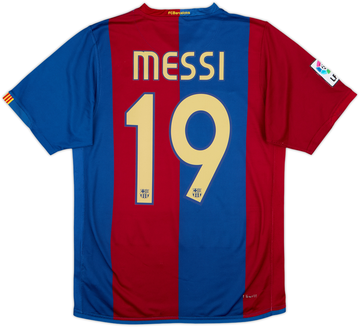
The shirt at the centre of it: Barcelona 2006-07 Home — median £79.99 across 50 live listings.
In September 2006, at the United Nations headquarters in New York, FC Barcelona did something it had never done in 107 years of existence: it put a logo on the front of its shirt. Not a corporate logo. Not an airline or a bank. UNICEF. And Barcelona paid them for it — €1.5 million a year [1].
It was the most Barcelona thing imaginable. After more than a century of refusing to sell the most valuable advertising space in football, the club broke its own rule in a way that let it claim it hadn't broken anything at all. The shirt was no longer blank, but it still felt pure. Joan Laporta, the club president who brokered the deal, called it "winning the Champions League on a social level" [1].
Four years later, the Qatar Foundation logo replaced UNICEF on the front of the shirt, and Barcelona were collecting €30 million a season — the biggest shirt sponsorship deal in football at the time [2]. UNICEF was moved to the back, beneath the player names, a gesture so diminished it was barely visible. The club had crossed the line it spent a century drawing, and it had crossed it for money.
This is the story of that journey, told through the shirts themselves. Because a football shirt is never just a shirt. It is a snapshot of what a club believed it stood for — and what it was willing to trade away.
Act I: The Blank Canvas (1899–2006)
Barcelona was founded in 1899 by Swiss businessman Joan Gamper and a group of Catalan, English, and German footballers. The blaugrana stripes — blue and deep red — were reportedly borrowed from the rugby kit of Merchant Taylors' School in Crosby, England, where two of the club's early Anglo-Spanish players studied [3].
But it was what the shirt didn't have that became the statement. For 107 years, the front of the Barcelona jersey carried nothing but the club badge, the manufacturer's logo, and the stripes. No sponsor. No advertisement. Just the colours.
This wasn't an accident or an oversight. It was policy, rooted in the club's identity as "més que un club" — more than a club. The phrase was coined by president Narcís de Carreras in his 1968 acceptance speech, and it wasn't marketing copy; it was a political declaration [4]. Under Franco's dictatorship, the Camp Nou was one of the few places Catalans could speak their language and express their identity. The shirt represented something beyond football, and selling advertising space on it would have felt like selling something sacred.
While Liverpool signed with Hitachi in 1979, while Arsenal partnered with JVC in 1981, while Manchester United carried Sharp across their chest from 1982, Barcelona held the line. Year after year, the shirt stayed blank. The refusal itself became a kind of anti-sponsor. The empty space was the message.
You can still buy those blank shirts. On Kitdex, Barcelona's 1984–85 home shirt — manufactured by Meyba (per historical records; Kitdex currently lists the manufacturer as unknown), sponsorless, worn when Terry Venables managed the club to a league title — carries a median price of £199.95, with 34 active listings, the highest-volume vintage Barcelona shirt on the platform [5]. The 1982–89 Meyba home sits at £211.78 [6]. The 1983–84 home has a sole recorded price of £295.66 [7]. These are accessible pieces of a Barcelona that no longer exists. The lack of a sponsor is precisely what makes them desirable.
Act II: The Genius Compromise (2006–2011)
When Laporta finally put a logo on the shirt in 2006, he did it in a way that looked like the opposite of selling out. Barcelona wasn't receiving money — it was giving it. The UNICEF logo wasn't an advertisement; it was a statement of solidarity. The club was using its global platform, and the most visible piece of real estate in sport, to direct attention to children affected by HIV/AIDS in Swaziland [1].
The genius of the UNICEF deal was that it allowed Barcelona to change without appearing to change. The shirt looked different — a small yellow UNICEF logo now sat in the center of the chest — but the story the club told about itself remained intact. Barcelona was still "més que un club." It was still different from everyone else. The UNICEF logo proved it.
The timing could not have been better. The 2006–2011 UNICEF era coincided with the greatest period in Barcelona's history. Ronaldinho gave way to Messi. Xavi and Iniesta turned possession into an art form. Pep Guardiola arrived in 2008 and won the treble in his first season — the first Spanish club ever to do so [8]. The UNICEF logo was on the shirt for all of it: the 2009 Champions League final in Rome, the 6–2 at the Bernabéu, the 5–0 against Mourinho's Madrid. For millions of fans, the UNICEF-branded Barcelona shirt is not a compromised version of the original. It is the definitive one.
But the deal also created a precedent. If the shirt could carry UNICEF, it could carry anything. Laporta had opened a door that couldn't be closed.
Act III: The Surrender (2011–Present)
In December 2010, Barcelona announced a five-year deal with the Qatar Foundation worth up to €150 million — €30 million per season. It was, by some distance, the richest shirt sponsorship in football. UNICEF moved to the back, a small logo beneath the player name. The front now read "Qatar Foundation" in Arabic script and English.
The backlash was immediate. Some fans saw it as a necessary evil — Barcelona's wage bill was among the highest in world sport. Others saw it as a betrayal. A club built on Catalan identity, democracy, and freedom of expression was now advertising an autocratic monarchy. The irony was hard to miss.
The Qatar Foundation deal was followed by Qatar Airways (2013–2017, starting at roughly €30 million and rising to approximately €35 million per season), then Japanese e-commerce giant Rakuten (2017–2022, €55 million per season), and finally Spotify (2022–present, approximately €280 million including Camp Nou naming rights — a four-year shirt deal with a separate three-year training kit component) [9].
Each new sponsor was bigger than the last. Each deal pushed the club further from the principle it once held sacred. The blank shirt of the Meyba years, the UNICEF shirt of the Guardiola era, the Qatar Foundation shirt of the early 2010s — these are not just different designs. They are different clubs wearing the same colours.
What the Shirts Tell Us
The Kitdex data confirms what collectors already know: the sponsorless Barcelona shirt occupies a distinct category of value. Unsponsored shirts from the 1970s and 1980s hold steady at £200–300 with consistent trading volume [5][6][7]. They are desirable not despite what they lack, but because of it. The blank shirt is a document of a football era that has definitively ended.
It is worth noting that Kitdex data reflects current marketplace listings and listed prices, not authenticated match-worn valuations. But the volume tells its own story: 34 active listings for the 1984–85 home shirt suggest sustained collector interest in the exact moment before the blank canvas disappeared.
The UNICEF-era shirts occupy a strange middle ground. They carry a logo, but it's a logo most collectors don't resent. A 2008–09 home shirt with UNICEF on the front, associated with the treble-winning season, commands premium prices in the resale market — not because it's rare, but because it represents a moment when Barcelona seemed to have cracked the code: commercially savvy without being commercially compromised. It turned out to be a temporary equilibrium.
The Qatar Foundation shirt, by contrast, marked the end of the illusion. From that point forward, Barcelona's shirt was just another billboard — a very expensive one, worn by very good players, but a billboard nonetheless. The club had spent 111 years building an identity around the refusal to sell, and it took one board meeting to dismantle it.
The Price of Being More Than a Club
Barcelona's shirt history is not a simple morality tale. The club that refused shirt sponsorship for 107 years was never purely altruistic — a blank shirt made Barcelona look different, and looking different had value. The UNICEF deal preserved that difference while opening a new revenue channel. The Qatar Foundation deal acknowledged what had been true for years: Barcelona's costs had outgrown Barcelona's principles.
But the story captures something larger than one club. It captures the arc of modern football — from community institution to global entertainment product, from identity to inventory. Every club that put a sponsor on its shirt in the 1980s made a concession to commerce. Barcelona held out longer than anyone, and when it finally conceded, it did so more visibly and more lucratively than anyone too.
The blank shirt, the UNICEF shirt, and the Qatar Foundation shirt are three acts of the same story. It ends with the recognition that, in football as in everything, there is always a number. Barcelona's number was €30 million a year.
Sources
[1] UN News, "UNICEF, Futbol Club Barcelona kick off partnership for kids in developing world," 8 September 2006. https://news.un.org/en/story/2006/09/191332
[2] The Guardian, "Barcelona agree €150m shirt sponsor deal with Qatar Foundation," 10 December 2010. https://www.theguardian.com/football/2010/dec/10/barcelona-shirt-sponsor-qatar-foundation
[3] Wikipedia, "FC Barcelona." https://en.wikipedia.org/wiki/FC_Barcelona
[4] Goal.com, "Mes que un club: Barcelona club motto meaning & history in Catalan independence," 1 October 2021. https://www.goal.com/en-us/news/mes-que-un-club-barcelona-club-motto-meaning-history-catalan-independence/c0e1i7haj3uh1hxu5wmid3qub
[5] Kitdex, "Barcelona 1984-85 Home," median price £199.95, 34 active listings. https://kitdex.app/shirt/barcelona-1984-85-home
[6] Kitdex, "Barcelona 1982-89 Home," median price £211.78, 3 active listings. https://kitdex.app/shirt/barcelona-1982-89-home
[7] Kitdex, "Barcelona 1983-84 Home," sole recorded price £295.66. https://kitdex.app/shirt/barcelona-1983-84-home
[8] Wikipedia, "2008–09 FC Barcelona season." First Spanish club to win treble (La Liga, Copa del Rey, Champions League).
[9] ESPN, "Barcelona add Spotify to Camp Nou name in new sponsorship deal," 15 March 2022. https://www.espn.com/soccer/story/_/id/37625318/barcelona-announce-spotify-sponsorship-deal