The Company That Invented the Replica Kit — and Got Buried by It
Seed: Admiral Sportswear and the birth of the replica football shirt market, 1973–1982
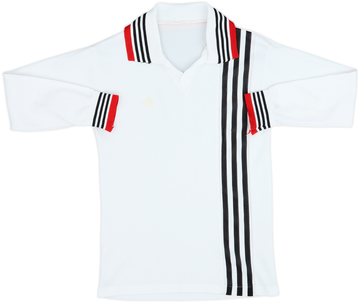
The Company That Invented the Replica Kit — and Got Buried by It
Seed: Admiral Sportswear and the birth of the replica football shirt market, 1973–1982
Cover image: /api/images/shirts/b7/b7cc0840c18492de181144bc7a4dea8e7e2cecaffb6bac2beedc6f486ee46217.webp
In 1973, Bert Patrick sat down for breakfast at Sheila's Café, a modest greasy spoon across the road from Elland Road stadium. He'd just come from a failed pitch at Kay's Catalogue headquarters in Holbeck — his Admiral tracksuits weren't going to appear in the mail-order catalogue that week. As he ate, the Leeds United first-team squad arrived for training at Fullerton Park, climbing the concrete steps beside the West Stand. Patrick walked over and struck up a conversation with Don Revie.
What came out of that conversation wasn't a tracksuit deal. It was the replica football shirt industry. [1]
Before that morning, replica kits as a commercial industry didn't exist. Umbro had produced youth football sets since 1959, but the idea that a supporter could walk into a shop and buy the exact shirt their heroes wore on Saturday — as a mass-market product marketed and sold at scale — hadn't been proven. Clubs bought plain shirts from local outfitters, stitched on a badge, and considered the matter closed. [2]
Patrick proposed something different: Admiral would design Leeds United's kits, pay the club for the privilege, and — this was the radical part — produce small-scale replicas for children to buy. Revie, protective of his team's all-white home strip inspired by Real Madrid, agreed on one condition: the home kit was sacrosanct. The away strip and training gear were open to reinvention. A handshake sealed it. [1]
The result was a vivid yellow away shirt with blue and white taping down the sleeves — a design detail never seen before on a British football kit. The Admiral logo sat on the chest alongside Leeds's "smiley" badge. Admiral paid Leeds £7,000. Children's replicas sold for roughly £5. [2]
This was 1973-74. The replica kit market did not exist before this deal. [3]
How an underwear company took over football
Admiral wasn't a sportswear giant. It began in 1914 as Cook & Hurst Ltd, a Leicester underwear manufacturer that supplied the Royal Navy during the First World War — hence the name Admiral, the navy's highest rank. [3]
The company pivoted to football kits after England's 1966 World Cup win. Bert Patrick believed colour television would change everything: fans would see kits more clearly, and clubs would want distinctive, registered designs. He was right about the television. He was right about the designs. What he underestimated was what happened after everyone else caught on. [3]
Following the Leeds deal, Admiral moved fast. In 1974, the company signed a five-year contract with the Football Association to produce England kits — the first commercially available England shirt with a manufacturer's logo. The deal was £15,000 per year or a 10% royalty. On 30 October 1974, England wore a branded Admiral shirt for the first time, against Czechoslovakia: a clean white shirt with one red and one blue stripe down each sleeve. [3] [4]
By the 1977-78 season, 84 of the 92 Football League clubs featured a prominent manufacturer's logo and sold replica kits for children. [2] Admiral added Manchester United, West Ham, Tottenham Hotspur, Southampton, Coventry City, and Portsmouth to its roster. The 1976 FA Cup final featured both sides — Manchester United and Southampton — in Admiral kits and tracksuits. [4]
Admiral expanded internationally, kitting out NASL teams in the United States, Red Star Belgrade, Eintracht Frankfurt, the Belgian and Welsh national teams, and Bob Marley — the singer was frequently photographed in Admiral tracksuits, which became closely associated with his off-stage look. [3] [4]
The shirts today
Admiral's Manchester United kits from the mid-1970s now trade as collectibles. The Kitdex market data shows three Admiral-manufactured United shirts currently tracked:
Manchester United 1975-76 Away — the yellow away shirt from the season that followed United's promotion back to the First Division. Admiral branding on the chest. Median price across recorded sales: £129.99, with two live listings available. View on Kitdex →
Manchester United 1976-77 Home — the red home shirt worn during United's FA Cup-winning campaign, when they beat Liverpool 2–1 at Wembley. Both sides wore Admiral that day. Median recorded price: £99.99. View on Kitdex →
Manchester United 1977-80 Special — a longer-running Admiral design spanning three seasons, including the 1979 FA Cup final appearance against Arsenal. Single recorded sale at £299.99, reflecting the scarcity of well-preserved examples. View on Kitdex →
These are not the most expensive vintage shirts on the platform. A Napoli 1926-13 home shirt, for comparison, recorded a sole price of £295.66 with a single listing. A Newcastle United 1978-79 home (Bukta) sits at £338.02 (historical marketSnapshot data; no current listings). What makes the Admiral shirts notable is their historical position — they are among the earliest commercially branded football shirts ever sold to the public, and they carry the logo of the company that started it all.
Why Admiral lost
By 1982, Admiral had peaked. The England kit worn at the 1982 World Cup in Spain — white with red and blue shoulder panels — has become a design classic, still reproduced as retro merchandise decades later. But the company was already in decline: Admiral was declared bankrupt in 1982, despite still holding the England kit contract. [4]
The problem wasn't the designs. Admiral took risks that Umbro and Adidas wouldn't: Coventry City's infamous chocolate-brown away kit, the Wales and Belgium national team variants, Leyton Orient's braces-style shirt. Some were ugly. Some were brilliant. None of them were safe. [4]
The problem was the fabric. As the 1980s progressed, Adidas and Umbro moved to lighter, silkier synthetic materials. Admiral stuck with heavier, scratchier polyester. The shirts that had looked revolutionary in 1974 felt dated by 1984. Clubs — the same clubs Admiral had taught to value branded kit deals — began switching to competitors offering better materials and larger sponsorship payments. [4]
The market Admiral created had matured, and Admiral couldn't afford to compete in it. Umbro signed the England contract in 1984. Adidas took Manchester United the same decade. Leeds, the club where it all began, left for Umbro, then returned to Admiral briefly in the early 1990s and again in 2005-06, but the second act never matched the first. [3]
What Admiral actually proved
The company still trades today, mostly in teamwear and retro reproductions. It never disappeared — it just stopped mattering at the top of the game. You won't find Admiral on any Premier League kit this season, and you haven't for years.
But Admiral proved something that every subsequent kit manufacturer depends on: that fans will pay to wear their club's identity. Before 1973, that was an unproven assumption. After 1973, it was an industry — one that now generates billions annually across replica kits, training wear, and licensed merchandise. [3]
The irony is sharper than it looks. Admiral invented the business model, proved the demand, built the market — and then got outspent in the market it built. Nike and Adidas now dominate kit supply not because they had a better idea, but because they had bigger chequebooks when the idea was already proven.
Bert Patrick's breakfast at Sheila's Café changed football forever. He just didn't get to profit from the change for very long.
Sources:
[1] Admiral Sports, "The Birth of the Modern Replica Kit: How Leeds United and Admiral Changed Football Forever" — admiralsports.com/blogs/journal, accessed October 2026
[2] The Guardian, "When did football fans first start wearing replica kits?" — 16 September 2026, theguardian.com/football
[3] Wikipedia, "Admiral Sportswear" — en.wikipedia.org/wiki/Admiral_Sportswear, accessed October 2026
[4] Urban Pitch / Admiral Sports, "When Admiral Were the Kings of Football Shirt Cool" — 29 July 2020, admiralsports.com/blogs/journal
Kitdex data: Manchester United Admiral shirts via kitdex.app/api/shirts?club=manchester-united. Prices in GBP, derived from API medianPrice.amount divided by 100.
Word count: ~1,100